
|
You entered: stars
 On the Origin of Gold
15.05.2005
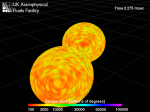
Where did the gold in your jewelry originate? No one is completely sure. The relative average abundance in our Solar System appears higher than can be made in the early universe, in stars, and even in typical supernova explosions.
 The Fox Fur Nebula
30.12.2015
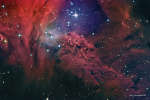
This interstellar canine is formed of cosmic dust and gas interacting with the energetic light and winds from hot young stars. The shape, visual texture, and color, combine to give the region the popular name Fox Fur Nebula.
 NGC 1977: Blue Reflection Nebula in Orion
22.07.2001
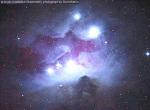
The Orion Nebula is visible to the unaided eye as a fuzzy patch near the famous belt of three stars in the Orion. The above picture captures a part of the Orion Nebula that primarily reflects light from bright Orion stars.
 Alborz Mountains in Moonlight
3.02.2007
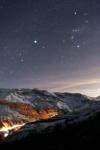
On January 25th, light from a first quarter Moon illuminated this dreamlike landscape looking across the rugged, snow-covered peaks of the Alborz Mountain Range in northern Iran. The stunning sky is filled with stars, including the yellow-tinged Betelgeuse at the shoulder of Orion.
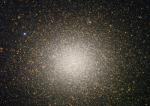 NGC 5139: Omega Centauri
19.04.2007
Centaurus is one of the most striking constellations in the southern sky. The Milky Way flows through this celestial expanse whose wonders also include the closest star system to the Sun, Alpha Centauri, and the largest globular star cluster in our galaxy, Omega Centauri (aka NGC 5139).
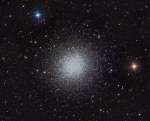 M13: The Great Globular Cluster in Hercules
14.06.2012
In 1716, English astronomer Edmond Halley noted, "This is but a little Patch, but it shews itself to the naked Eye, when the Sky is serene and the Moon absent." Of course, M13 is now modestly recognized as the Great Globular Cluster in Hercules, one of the brightest globular star clusters in the northern sky.
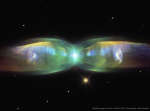 M2 9: Wings of a Butterfly Nebula
24.07.2016
Are stars better appreciated for their art after they die? Actually, stars usually create their most artistic displays as they die. In the case of low-mass stars like our Sun and M2-9 pictured above, the stars transform themselves from normal stars to white dwarfs by casting off their outer gaseous envelopes.
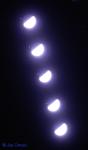 Regulus Occulted
2.08.1999
On May 21, viewed from the continental US, a star winked out as it passed behind the dark limb of the first-quarter Moon. The star, Regulus, is hotter than the sun, about 69 light-years distant, and shines in Earth's skies as the brightest star in the constellation Leo, the Lion.
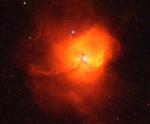 N81: Starbirth in the SMC
27.07.1998
A very young star cluster has been discovered in a neighboring galaxy. The stars found in this cluster, dubbed N81, are so young and massive that they furiously eject matter and light up the surrounding nebula. The ejected stellar winds combine and interact to sculpt beautiful and complex structures.
 APOD: 2025 January 22 Б The North America Nebula
22.01.2025
The North America nebula on the sky can do what the North America continent on Earth cannot -- form stars. Specifically, in analogy to the Earth-confined continent, the bright part that appears as the east coast is actually a hot bed of gas, dust, and newly formed stars known as the Cygnus Wall.
|
January February March April May June July August September October |
|||||||||||||||||||||||||||||||||||||||||||||||||