
|
You entered: SDSS
 Baryon Acoustic Oscillations from SDSS III
20.01.2014
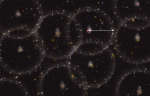
How large do things appear when far away? When peering across the universe, the answer can actually tell us about its average gravitational history and hence its composition. Toward this goal, the Baryon Oscillation...
 The SDSS 3D Universe Map
28.10.2003
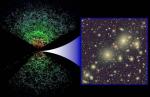
The latest map of the cosmos again indicates that dark matter and dark energy dominate our universe. The Sloan Digital Sky Survey (SDSS) is on its way to measuring the distances to over one million galaxies.
 The Sloan Digital Sky Survey Telescope
17.06.1998
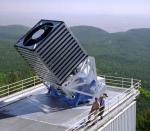
The Sloan Digital Sky Survey (SDSS) will soon begin. Pictured above is the 2.5-meter telescope poised to create the most ambitious sky map in the history of astronomy. SDSS will catalog one quarter of the sky down past 23rd magnitude ( R), obtaining redshifts for galaxies and quasars brighter than magnitude 19.
 A Flight Through the Universe
13.08.2012
What would it be like to fly through the universe? Possibly the best simulated video of this yet has been composed from recently-released galaxy data from the Sloan Digital Sky Survey. Every spot in the above video is a galaxy containing billions of stars.
 J102815: A Star That Should Not Exist
7.09.2011
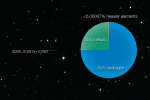
Why does this star have so few heavy elements? Stars born in the generation of our Sun have an expected abundance of elements heavier than hydrogen and helium mixed into their atmospheres. Stars born...
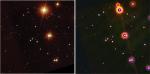 GRB 060218: A Mysterious Transient
27.02.2006
What is it? Something is happening in a small portion of the sky toward the constellation of Aries and telescopes around the globe are tracking an unusual transient there as it changes day by day. No one is sure what it will do next.
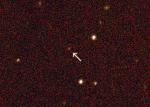 Redshift 5.8: A New Farthest Quasar
19.04.2000
The distance record for a quasar has been broken yet again. At the present time, no other object in the universe has been found to be more distant than the above speck. The recently discovered quasar has been clocked at redshift 5.82.
 APOD: 2025 November 2 Б A Horseshoe Einstein Ring from Hubble
2.11.2025
What's large and blue and can wrap itself around an entire galaxy? A gravitational lens mirage. Pictured here, the gravity of a massive elliptical galaxy (luminous red galaxy: LRG) has gravitationally distorted the light from a much more distant blue galaxy.
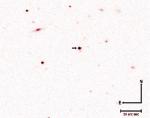 Is Mystery Object an Orphan Afterglow
12.11.2001
What is that unusual object? Astronomers can identify most objects that are imaged on the sky, but not all. Pictured above is one that currently defies classification. Attributes of the object include that it has unusual colors, appears to be fading as months go by, and appears to be associated with a distant galaxy.
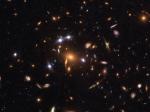 A Five Quasar Gravitational Lens
24.05.2006
What's happening near the center of this cluster of galaxies? At first glance, it appears that several strangely elongated galaxies and fully five bright quasars exist there. In reality, an entire cluster of galaxies is acting as a gigantic gravitational lens that distorts and multiply-images bright objects that occur far in the distance.
|
January February March April May June July August September |
|||||||||||||||||||||||||||||||||||||||||||||||||