
|
You entered: camera
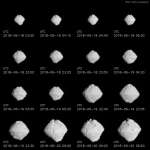 Hayabusa2 Approaches Asteroid Ryugu
25.06.2018
It looks like a big space diamond -- but with craters. It's 162173 Ryugu (Dragon's Castle), and Japan's robotic Hayabusa2 mission is now arriving at this near-Earth asteroid. Ambitious Hayabusa2 is carrying...
 M1: The Crab Nebula
9.11.2023
The Crab Nebula is cataloged as M1, the first object on Charles Messier's famous 18th century list of things which are not comets. In fact, the Crab is now known to be a supernova remnant, debris from the death explosion of a massive star witnessed by astronomers in the year 1054.
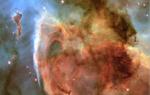 Colorful Clouds Of Carina
3.02.2000
Tumultuous clouds of the Carina Nebula, 8000 light-years away, glow in planet Earth's southern sky. Striking and detailed, this close-up of a portion of the famous nebula is a combination of exposures through six different filters taken with the Hubble Space Telescope's Wide Field Planetary Camera 2 in April of 1999.
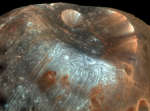 Stickney Crater
18.01.2013
Stickney Crater, the largest crater on the martian moon Phobos, is named for Chloe Angeline Stickney Hall, mathematician and wife of astronomer Asaph Hall. Asaph Hall discovered both the Red Planet's moons in 1877.
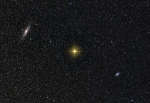 M31 versus M33
26.09.2015
Separated by about 14 degrees (28 Full Moons) in planet Earth's sky, spiral galaxies M31 at left, and M33 are both large members of the Local Group, along with our own Milky Way galaxy.
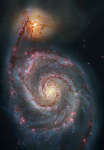 M51 Hubble Remix
26.12.2009
The 51st entry in Charles Messier's famous catalog is perhaps the original spiral nebula - a large galaxy with a well defined spiral structure also cataloged as NGC 5194. Over 60,000 light-years across, M51's spiral arms and dust lanes clearly sweep in front of its companion galaxy (right), NGC 5195.
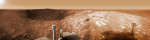 Opportunity at Santa Maria Crater
29.01.2011
Celebrating 7 years on the surface of the Red Planet, Mars exploration rover Opportunity now stands near the rim of 90 meter wide Santa Maria crater. Remarkably, Opportunity and its fellow rover Spirit were initially intended for a 3 month long primary mission.
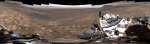 Mars Panorama from Curiosity
6.03.2020
The Mars Rover named Curiosity recorded high-resolution, 360 degree views of its location on Mars late last year. The panoramic scene was stitched from over 1,000 images from Curiosity's Mast camera or Mastcam.
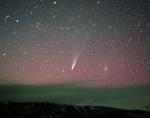 Ikeya Zhang: Comet Over Colorado
4.04.2002
Comet Ikeya-Zhang ("ee-KAY-uh JONG") has become a most photogenic comet. This lovely early evening view of the comet in Rocky Mountain skies looks northwest over ridges and low clouds. The time exposure was recorded on March 31st from an 8,000 foot elevation near Yampa, Colorado, USA.
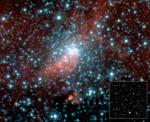 Glimpse of a Globular Star Cluster
14.10.2004
Not a glimpse of this cluster of stars can be seen in the inset visible light image (lower right). Still, the infrared view from the Spitzer Space Telescope reveals a massive globular star cluster of about 300,000 suns in an apparently empty region of sky in the constellation Aquila.
|
January February March April May June July August |
||||||||||||||||||||||||||||||||||||||||||||||||||||||||