
|
You entered: camera
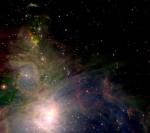 UKIRT: Aloha Orion
6.01.2005
At the edge of a dense molecular cloud, filaments of gas, cosmic dust, and a multitude of young stars beckon in this penetrating image of the Orion Nebula. Alluring structures in the well-known star...
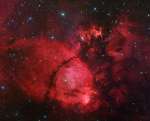 The Color of IC 1795
13.10.2011
This sharp cosmic portrait features glowing gas and obscuring dust clouds in IC 1795, a star forming region in the northern constellation Cassiopeia. Also cataloged as NGC 896, the nebula's remarkable details, shown...
 Our Rotating Earth
1.07.2020
Has your world ever turned upside-down? It would happen every day if you stay fixed to the stars. Most time-lapse videos of the night sky show the stars and sky moving above a steady Earth.
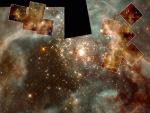 Massive Stars of 30 Doradus
22.06.2003
In the center of star-forming region 30 Doradus lies a huge cluster of the largest, hottest, most massive stars known. These stars and part of the surrounding nebula are captured here in this gorgeous visible-light Hubble Space Telescope image.
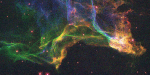 Cygnus Loop Supernova Shockwave
18.07.1995
15,000 years ago a star in the constellation of Cygnus exploded. This picture shows a portion of a shockwave from this supernova explosion still expanding past nearby stars. The collision of this gaseous...
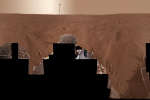 A Mars Panorama from the Phoenix Lander
12.08.2008
If you could stand on Mars, what would you see? The robotic Phoenix spacecraft that just landed on Mars in May recorded the above spectacular panorama. The above image is actually a digital combination of over 100 camera pointings and surveys fully 360 degrees around the busy robotic laboratory.
 Earth at Night
7.12.2012
This remarkably complete view of Earth at night is a composite of cloud-free, nighttime images. The images were collected during April and October 2012 by the Suomi-NPP satellite from polar orbit about 824 kilometers (512 miles) above the surface using its Visible Infrared Imaging Radiometer Suite (VIIRS).
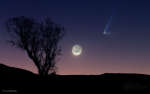 Comet PanSTARRS and a Crescent Moon
20.07.2015
A comet has brightened quickly and unexpectedly. Discovered last year, Comet C/2014 Q1 (PanSTARRS) is expected to be visible now for a few days to the unaided eye, just after sunset, from some locations. The comet rounded the Sun on July 6 and apparently has shed quite a bit of gas and dust.
 Planet Earth from Orion
17.11.2022
A Space Launch System rocket left planet Earth on Wednesday, November 16 at 1:47am EST carrying the Orion spacecraft on the Artemis 1 mission, the first integrated test of NASAБs deep space exploration systems.
 APOD: 2024 September 25 Б Comet A3 Through an Australian Sunrise
25.09.2024
Comet Tsuchinshan-ATLAS is now visible in the early morning sky. Diving into the inner Solar System at an odd angle, this large dirty iceberg will pass its closest to the Sun -- between the orbits of Mercury and Venus -- in just two days.
|
January February March April May June July August |
||||||||||||||||||||||||||||||||||||||||||||||||||||||||