
|
You entered: light
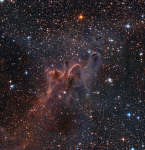 Cometary Globules
12.10.2013
Bright-rimmed, flowing shapes gather near the center of this rich starfield toward the boarders of the nautical southern constellations Pupis and Vela. Composed of interstellar gas and dust, the grouping of light-year sized cometary globules is about 1300 light-years distant.
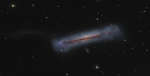 The Tail of the Hamburger Galaxy
8.05.2014
Sharp telescopic views of NGC 3628 show a puffy galactic disk divided by dark dust lanes. Of course, this deep portrait of the magnificent, edge-on spiral galaxy puts some astronomers in mind of its popular moniker, the Hamburger Galaxy.
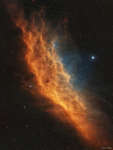 NGC 1499: The California Nebula
6.11.2018
There's even a California in space. Drifting through the Orion Arm of the spiral Milky Way Galaxy, this cosmic cloud by chance echoes the outline of California on the west coast of the United States.
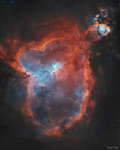 IC 1805: The Heart Nebula
11.09.2019
What energizes the Heart Nebula? First, the large emission nebula dubbed IC 1805 looks, in whole, like a human heart. The nebula glows brightly in red light emitted by its most prominent element: hydrogen. The red glow and the larger shape are all powered by a small group of stars near the nebula's center.
 APOD: 2023 December 6 Б Stars Verus Dust in the Carina Nebula
6.12.2023
It's stars versus dust in the Carina Nebula and the stars are winning. More precisely, the energetic light and winds from massive newly formed stars are evaporating and dispersing the dusty stellar nurseries in which they formed.
 APOD: 2024 April 14 Б How a Total Solar Eclipse Ended
14.04.2024
How does a total solar eclipse end? Yes, the Moon moves out from fully blocking the Sun, but in the first few seconds of transition, interesting things appear. The first is called a diamond ring.
 Stardust in the Perseus Molecular Cloud
25.01.2025
Clouds of stardust drift through this deep skyscape, across the Perseus molecular cloud some 850 light-years away. Dusty nebulae reflecting light from embedded young stars stand out in the nearly 4 degree wide field of view. With a characteristic bluish color reflection nebula NGC 1333 is prominent near center.
 APOD: 2025 August 1 Б Small Dark Nebula
1.08.2025
A small, dark, nebula looks isolated near the center of this telescopic close-up. The wedge-shaped cosmic cloudlet lies within a relatively crowded region of space though. About 7,000 light-years distant and filled with glowing gas and an embedded cluster of young stars, the region is known as M16 or the Eagle Nebula.
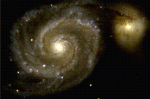 M51: The Whirlpool Galaxy
18.12.1995
The Whirlpool Galaxy is frequently given as an example of a galaxy with classic spiral design. At only 15 million light years distant, M51, also cataloged as NGC 5194, is also one of the brighter and more picturesque galaxies on the sky.
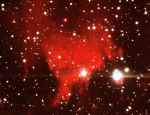 Nebula Nova Cygni Turns On
16.12.1996
Old photographs show no evidence of the above nebula. In 1992, a white dwarf star in Cygnus blew off its outer layers in a classical nova explosion: an event called Nova Cygni 1992. Light flooded the local interstellar neighborhood, illuminated this existing gas cloud, excited the existing hydrogen, and hence caused the red emission.
|
January February March April May June July August September October |
|||||||||||||||||||||||||||||||||||||||||||||||||