
|
You entered: surface
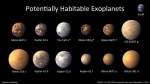 Habitable Worlds
3.03.2014
Is Earth the only known world that can support life? In an effort to find life-habitable worlds outside our Solar System, stars similar to our Sun are being monitored for slight light decreases that indicate eclipsing planets. Many previously-unknown planets are being found, including over 700 worlds recently uncovered by NASA's Kepler satellite.
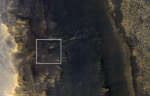 Opportunity After the Storm
4.10.2018
On Mars dust storms can't actually blow spacecraft over, but they can blot out the Sun. Over three months ago a planet-wide dust storm caused a severe lack of sunlight for the Mars rover Opportunity at its location near the west rim of Endeavor crater.
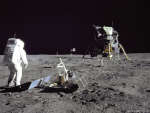 Moonquakes Surprisingly Common
21.07.2019
Why are there so many moonquakes? Analyses of seismometers left on the moon by the Apollo moon landings reveals a surprising number of moonquakes occurring within 100 kilometers of the surface. In fact, 62 moonquakes were detected in data recorded between 1972 and 1977.
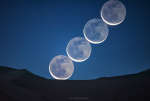 Da Vinci Rise
26.09.2019
An old Moon rose this morning, its waning sunlit crescent shining just above the eastern horizon before sunrise. But earthshine, light reflected from a bright planet Earth, lit the shadowed portion of the lunar disk and revealed most of a familiar lunar near side to early morning risers.
 A Little Like Mars
5.03.2021
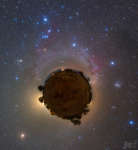
The surface of this planet looks a little like Mars. It's really planet Earth though. In a digitally stitched little planet projection, the 360 degree mosaic was captured near San Pedro in the Chilean Atacama desert. Telescopes in domes on the horizon are taking advantage of the region's famously dark, clear nights.
 Perseverance Takes a Spin
6.03.2021
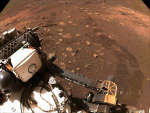
After arriving at Jezero Crater on Mars, Perseverance went for a spin on March 4. This sharp image from the car-sized rover's Navcam shows tracks left by its wheels in the martian soil. In preparation for operations on the surface of the Red Planet, its first drive lasted about 33 minutes.
 In Chandor Chasma on Mars
31.05.2002
Scroll right and dive into a spectacular canyon on Mars. This daytime infrared view, recently recorded by the THEMIS camera on board the orbiting Mars Odyssey spacecraft, covers a 30 by 175 kilometer swath running along the canyon floor.
 Earth at Night
10.08.2002
This is what the Earth looks like at night. Can you find your favorite country or city? Surprisingly, city lights make this task quite possible. Human-made lights highlight particularly developed or populated areas of the Earth's surface, including the seaboards of Europe, the eastern United States, and Japan.
 Martian Moon Phobos from MGS
1.07.2003
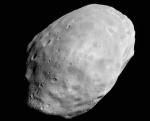
Why is Phobos so dark? Phobos, the largest and innermost of two Martian moons, is the darkest moon in the entire Solar System. Its unusual orbit and color indicate that it may be a captured asteroid composed of a mixture of ice and dark rock.
 October Mars
28.10.2005
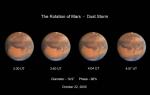
This October, Mars has become a bright, yellowish star in planet Earth's sky as it approaches oppositon, the period when Mars and Earth pass close as they orbit the Sun. How close is Mars? A mere 70 million kilometers or so, close enough to allow Earth-bound astronomers excellent views of the alluring Red Planet.
|
January February March April May June July August September October |
|||||||||||||||||||||||||||||||||||||||||||||||||