
|
You entered: surface
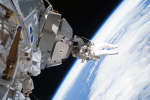 Astronaut Installs Panoramic Space Window
23.02.2010
This space job was almost complete. Floating just below the International Space Station, astronaut Nicholas Patrick put some finishing touches on the newly installed cupola space windows last week. Patrick was a mission specialist onboard the recently completed space shuttle Endeavor's STS-130 mission to the ISS.
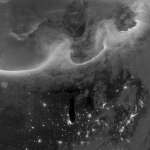 Aurorae over Planet Earth
11.10.2012
North America at night is easy to recognize in this view of our fair planet from orbit, acquired by the Suomi-NPP satellite on October 8. The spectacular waves of visible light emission rolling above the Canadian provinces of Quebec and Ontario in the upper half of the frame are the Aurora Borealis or northern lights.
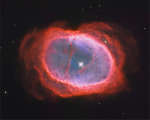 NGC 3132: The Southern Ring Nebula
9.04.2013
It's the dim star, not the bright one, near the center of NGC 3132 that created this odd but beautiful planetary nebula. Nicknamed the Eight-Burst Nebula and the Southern Ring Nebula, the glowing gas originated in the outer layers of a star like our Sun.
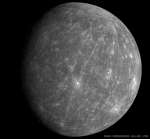 Mercury as Revealed by MESSENGER
22.07.2017
Mercury had never been seen like this before. In 2008, the robotic MESSENGER spacecraft buzzed past Mercury for the second time and imaged terrain mapped previously only by comparatively crude radar. The featured image was recorded as MESSENGER looked back 90 minutes after passing, from an altitude of about 27,000 kilometers.
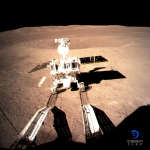 Yutu 2 on the Farside
4.01.2019
On January 3, the Chinese Chang'e-4 spacecraft made the first successful landing on the Moon's farside. Taken by a camera on board the lander, this image is from the landing site inside Von Karman crater.
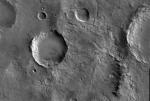 Help NASA Classify Martian Craters
7.01.2001
The large Martian crater above just left of center: is this a fresh crater, a degraded crater, or a ghost crater? Complex image recognition tasks like these are currently done more reliably by a human than a computer.
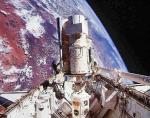 Astro 2 In Orbit
16.03.2001
Six years ago, a cluster of three ultraviolet telescopes flew into orbit on the Astro-2 mission aboard the space shuttle Endeavour. Seen here perched in Endeavour's payload bay about 350 kilometers above the Australian desert are the Hopkins Ultraviolet Telescope (HUT), the Ultraviolet Imaging Telescope (UIT), and the Wisconsin Ultraviolet Photo-Polarimeter Experiment (WUPPE).
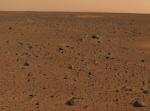 Red Mars from Spirit
6.01.2004
Rocks are strewn across the broad, flat Gusev crater floor in this sharp color picture from NASA's Spirit rover. Recorded by the rover's panoramic camera, the picture is part of Spirit's first color image of Mars - the highest resolution picture yet taken on the surface of another planet.
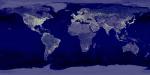 Earth at Night
22.08.2004
This is what the Earth looks like at night. Can you find your favorite country or city? Surprisingly, city lights make this task quite possible. Human-made lights highlight particularly developed or populated areas of the Earth's surface, including the seaboards of Europe, the eastern United States, and Japan.
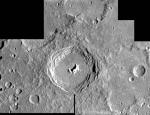 SMART 1: Pythagoras Crater
2.02.2005
Stark shadows show off the central peaks and terraced walls of 120 kilometer wide Pythagoras Crater in this mosaic of images from ESA's SMART-1 spacecraft. Characteristic of large, complex impact craters on the Moon, the central uplift was produced by a rebound of the suddenly molten lunar crust during the violent impact event.
|
January February March April May June July August September October |
|||||||||||||||||||||||||||||||||||||||||||||||||