
|
You entered: surface
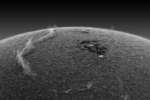 A Filament Across the Sun
20.08.2012
Is that a cloud hovering over the Sun? Yes, but it is quite different than a cloud hovering over the Earth. The long light feature on the left of the above color-inverted image is actually a solar filament and is composed of mostly charged hydrogen gas held aloft by the Sun's looping magnetic field.
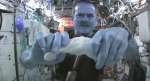 Wringing a Wet Towel in Orbit
24.04.2013
What happens if you wring out a wet towel while floating in space? The water shouldn't fall toward the floor because while orbiting the Earth, free falling objects will appear to float. But will the water fly out from the towel, or what? The answer may surprise you.
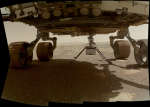 Ingenuity on Sol 39
2.04.2021
The Mars Ingenuity Helicopter, all four landing legs down, was captured here on sol 39 (March 30) slung beneath the belly of the Perseverance rover. The near ground level view is a mosaic of images from the WATSON camera on the rover's SHERLOC robotic arm.
 3I/ATLAS: A View from Planet Earth
20.11.2025
Now outbound after its perihelion or closest approach to the Sun on October 29, Comet 3I/ATLAS is only the third known interstellar object to pass through our fair Solar System. Its greenish coma...
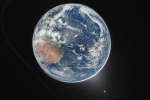 APOD: 2026 April 4 Б Hello World
3.04.2026
From pole to pole our fair planet is captured in this snapshot from space, an evocative image from a window of the Orion spacecraft Integrity. From the spacecraft's perspective the Sun is moving behind Earth's bright limb along the lower right.
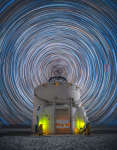 APOD: 2026 August 28 Б The Sky Turns Above Paranal
27.08.2026
At the latitude of ESO's Paranal Observatory in Chile, about 25 degrees south, Earth's rotation moves the planet's surface eastward at over 1,500 kilometers per hour. And while that's faster than the speed of sound at sea level, the motion is imperceptible.
 Jupiter from Voyager
25.06.1995
Imagine a hurricane that lasted for 300 years! This picture of the planet Jupiter was taken by the Voyager 1 spacecraft as it passed the planet in 1979. Jupiter, a gas giant planet with no solid surface, is the largest planet in the solar system and is made mostly of the hydrogen and helium.
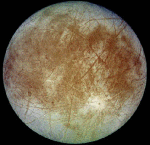 Europa Full Face
19.11.1996
What mysteries might be solved by peering into this crystal ball? This crystal ball is quite unusual because it is actually a moon of Jupiter, the crystals are ice-crystals, and the ball is not only dirty and opaque but cracked beyond repair.
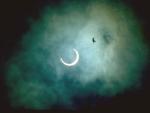 A Fleeting Eclipse
27.08.1997
A lunar eclipse can be viewed in a leisurely fashion. Visible to anyone on the night side of planet Earth (weather permitting), totality often lasts an hour or so as the moon glides through the Earth's shadow. But a solar eclipse is more fleeting.
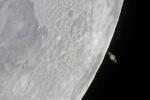 The Moon s Saturn
26.05.2007
On May 22nd, just days after sharing the western evening sky with Venus, the Moon moved on to Saturn - actually passing in front of the ringed planet when viewed in skies over Europe, northern Africa, and western Asia.
|
January February March April May June July August September October |
|||||||||||||||||||||||||||||||||||||||||||||||||