
|
You entered: distance
 APOD: 2024 December 24 Б Fox Fur, Cone, and Christmas Tree
23.12.2024
What do the following things have in common: a cone, the fur of a fox, and a Christmas tree? Answer: they all occur in the constellation of the Unicorn (Monoceros). Considered as a star...
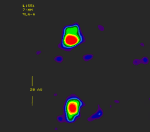 Twin Proto Planetary Disks
25.09.1998
Sun-like stars are forming - and probably planets too - hidden inside Lynds 1551, an interstellar cloud of molecular gas and dust in the constellation Taurus. Using new receivers, coordinated radio telescopes at the Very Large Array near Socorro, New Mexico, USA, can now sharply image the dusty proto-planetary disks surrounding these young stars at radio wavelengths.
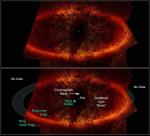 Ring Around Fomalhaut
1.07.2005
Fomalhaut (sounds like "foam-a-lot") is a bright, young, star, a mere 25 light-year trip from planet Earth in the direction of the constellation Piscis Austrinus. Earlier infrared observations identified a torus of cold material...
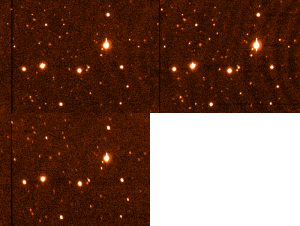 Orcus of the Outer Solar System
24.03.2009
A newly discovered object in the outer Solar System moves like an anti-Pluto. 90482 Orcus was first discovered in 2004 and is slightly smaller than Pluto, although still one of the largest Kuiper belt objects known. Orcus may one day have the same IAU designation as Pluto: a dwarf planet.
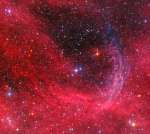 WR 134 Ring Nebula
21.06.2012
Made with narrow and broad band filters, this colorful cosmic snap shot covers a field of view about the size of the full Moon within the boundaries of the constellation Cygnus. It highlights the bright edge of a ring-like nebula traced by the glow of ionized hydrogen and oxygen gas.
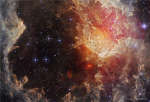 NGC 7822: Stars and Dust Pillars in Infrared
18.11.2017
Young stars themselves are clearing out their nursery in NGC 7822. Within the nebula, bright edges and complex dust sculptures dominate this detailed skyscape taken in infrared light by NASA's Wide Field Infrared Survey Explorer (WISE) satellite.
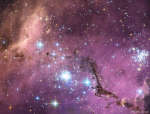 N11: Star Clouds of the LMC
28.04.2019
Massive stars, abrasive winds, mountains of dust, and energetic light sculpt one of the largest and most picturesque regions of star formation in the Local Group of Galaxies. Known as N11, the region...
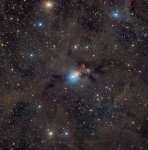 Stardust in the Perseus Molecular Cloud
17.03.2021
Clouds of stardust drift through this deep skyscape, across the Perseus molecular cloud some 850 light-years away. Dusty nebulae reflecting light from embedded young stars stand out in the nearly 2 degree wide telescopic field of view.
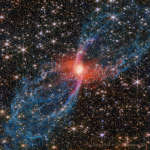 APOD: 2026 February 3 Б Red Spider Planetary Nebula from Webb
2.02.2026
Oh what a tangled web a planetary nebula can weave. The Red Spider Planetary Nebula shows the complex structure that can result when a normal star ejects its outer gases and becomes a white dwarf star.
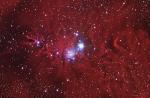 Fox Fur, the Unicorn, and a Christmas Tree
27.02.2003
Glowing hydrogen gas fills this gorgeously detailed sky view centered on the variable star S Mon in the faint but fanciful constellation Monoceros, the Unicorn. A star forming region (NGC 2264), the complex jumble...
|
January February March April May June July August September October |
|||||||||||||||||||||||||||||||||||||||||||||||||