
|
You entered: distance
 Cat s Eye Wide and Deep
25.05.2023
The Cat's Eye Nebula (NGC 6543) is one of the best known planetary nebulae in the sky. Its more familiar outlines are seen in the brighter central region of the nebula in this impressive wide-angle view. But this wide and deep image combining data from two telescopes also reveals its extremely faint outer halo.
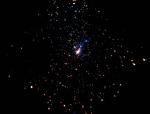 X Ray Stars in the Orion Nebula
19.05.2005
When our middle-aged Sun was just a few million years old it was thousands of times brighter in x-rays. In fact, it was likely similar to some of the stars found in this false-color x-ray composite of the Orion Nebula region from the Chandra Observatory.
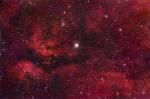 Central Cygnus
4.01.2007
Supergiant star Gamma Cygni lies at the center of the Northern Cross, famous asterism in the constellation Cygnus the Swan. Known by the proper name Sadr, the bright star also lies at the center...
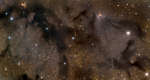 Dark Clouds in Aquila
29.06.2012
Part of a dark expanse that splits the crowded plane of our Milky Way galaxy, the Aquila Rift arcs through the northern hemisphere's summer skies near bright star Altair and the Summer Triangle...
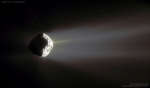 Comet Churyumov Gerasimenko in Crescent
29.04.2015
What's happening to Comet 67P/ChuryumovGerasimenko? As the 3-km wide comet moves closer to the Sun, heat causes the nucleus to expel gas and dust. The Rosetta spacecraft arrived at the comet's craggily double nucleus last July and now is co-orbiting the Sun with the giant dark iceberg.
 Peculiar Galaxies of Arp 273
5.01.2017
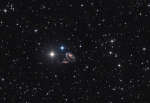
The spiky stars in the foreground of this sharp cosmic portrait are well within our own Milky Way Galaxy. The two eye-catching galaxies lie far beyond the Milky Way, at a distance of over 300 million light-years. Their distorted appearance is due to gravitational tides as the pair engage in close encounters.
 APOD: 2023 January 23 Б The Colliding Spiral Galaxies of Arp 274
23.01.2023
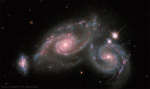
Two galaxies are squaring off in Virgo and here are the latest pictures. When two galaxies collide, the stars that compose them usually do not. This is because galaxies are mostly empty space and, however bright, stars only take up only a small fraction of that space.
 Phantoms in Cassiopeia
26.10.2024
These brightly outlined flowing shapes look ghostly on a cosmic scale. A telescopic view toward the constellation Cassiopeia, the colorful skyscape features the swept-back, comet-shaped clouds IC 59 (left) and IC 63. About 600 light-years distant, the clouds aren't actually ghosts.
 Southern Geminids
18.12.2009
At least 34 meteors are included in this composite image as they rain through Australian skies during the annual Geminid Meteor shower. Dust particles strung out along the orbit of extinct comet Phaethon vaporize when they plow through planet Earth's atmosphere causing the impressive display.
 NGC 7822 in Cepheus
11.11.2016
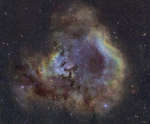
Hot, young stars and cosmic pillars of gas and dust seem to crowd into NGC 7822. At the edge of a giant molecular cloud toward the northern constellation Cepheus, the glowing star forming region lies about 3,000 light-years away. Within the nebula, bright edges and dark shapes stand out in this colorful skyscape.
|
January February March April May June July August September October |
|||||||||||||||||||||||||||||||||||||||||||||||||