
|
You entered: distance
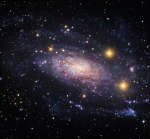 NGC 3621: Far Beyond the Local Group
24.02.2017
Far beyond the local group of galaxies lies NGC 3621, some 22 million light-years away. Found in the multi-headed southern constellation Hydra, the winding spiral arms of this gorgeous island universe are loaded with luminous blue star clusters, pinkish starforming regions, and dark dust lanes.
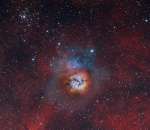 Composite Messier 20 and 21
28.06.2017
The beautiful Trifid Nebula, also known as Messier 20, lies about 5,000 light-years away, a colorful study in cosmic contrasts. It shares this nearly 1 degree wide field with open star cluster Messier 21 (top left).
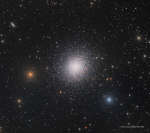 M13: The Great Globular Cluster in Hercules
19.03.2020
In 1716, English astronomer Edmond Halley noted, "This is but a little Patch, but it shews itself to the naked Eye, when the Sky is serene and the Moon absent." Of course...
 APOD: 2024 October 2 Б The Large Magellanic Cloud Galaxy
2.10.2024
It is the largest satellite galaxy of our home Milky Way Galaxy. If you live in the south, the Large Magellanic Cloud (LMC) is quite noticeable, spanning about 10 degrees across the night sky, which is 20 times larger than the full moon towards the southern constellation of the dolphinfish (Dorado).
 APOD: 2025 August 14 Б M13: The Great Globular Cluster in Hercules
14.08.2025
In 1716, English astronomer Edmond Halley noted, "This is but a little Patch, but it shews itself to the naked Eye, when the Sky is serene and the Moon absent." Of course...
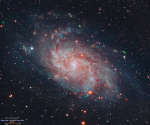 APOD: 2026 September 18 Б Messier 33: The Triangulum Galaxy
18.09.2026
The small, northern constellation Triangulum harbors this magnificent face-on spiral galaxy, Messier 33. Its popular names include the Pinwheel Galaxy or just the Triangulum Galaxy. M33 is over 50,000 light-years in diameter, third largest in the Local Group of galaxies after the Andromeda Galaxy (M31), and our own Milky Way.
 NGC 1 and NGC 2
19.08.2005
Beautiful nebulae, clusters, and galaxies that grace planet Earth's night sky are often known by their New General Catalog designation or NGC number. That classic listing was compiled by John Louis Emil Dreyer, remarkable director of the Armagh Observatory from 1882 to 1916.
 Victoria Crater on Mars
22.10.2007
Scroll right to see the largest crater yet visited by a rover on Mars. Reaching the expansive Victoria Crater has been a goal for the robotic Opportunity rover rolling across Mars for the past two years. Victoria crater has about five times the diameter of Endurance Crater, which Opportunity spent six months exploring.
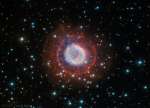 Planetary Nebula NGC 2438
7.04.2011
NGC 2438 is a planetary nebula, the gaseous shroud cast off by a dying sunlike star billions of years old whose central reservoir of hydrogen fuel has been exhausted. About 3,000 light-years distant it lies within the boundaries of the nautical constellation Puppis.
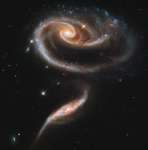 Peculiar Galaxies of Arp 273
21.04.2011
The spiky stars in the foreground of this sharp cosmic portrait are well within our own Milky Way Galaxy. The two eye-catching galaxies lie far beyond the Milky Way, at a distance of over 300 million light-years. Their distorted appearance is due to gravitational tides as the pair engage in close encounters.
|
January February March April May June July August September October |
|||||||||||||||||||||||||||||||||||||||||||||||||