
|
You entered: distance
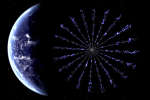 Heliopause Electrostatic Rapid Transit System
16.04.2016
Want to take a fast trip to the edge of the Solar System? Consider a ride on a Heliopause Electrostatic Rapid Transit System (HERTS). The concept is currently being tested and it might take only 10 to 15 years to make the trip of over 100 Astronomical Units (15 billion kilometers).
 APOD: 2024 May 12 Б Red Aurora over Poland
12.05.2024
Northern lights don't usually reach this far south. Magnetic chaos in the Sun's huge Active Region 3664, however, produced a surface explosion that sent a burst of electrons, protons, and more massive, charged nuclei into the Solar System.
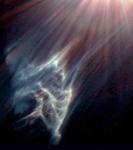 Reflecting Merope
6.12.2000
In the famous Pleiades star cluster, a star's light is slowly destroying a passing cloud of gas and dust. The star, Merope, lies just off the upper right edge of this recently released picture by the Hubble Space Telescope.
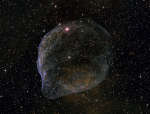 Sharpless 308: Star Bubble
24.12.2013
Blown by fast winds from a hot, massive star, this cosmic bubble is huge. Cataloged as Sharpless 2-308 it lies some 5,200 light-years away toward the constellation of the Big Dog (Canis Major) and covers slightly more of the sky than a Full Moon.
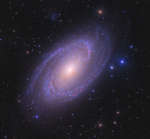 Bright Spiral Galaxy M81
17.10.2015
One of the brightest galaxies in planet Earth's sky is similar in size to our Milky Way Galaxy: big, beautiful M81. The grand spiral galaxy can be found toward the northern constellation of the Great Bear (Ursa Major).
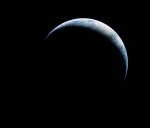 Apollo 17: The Crescent Earth
29.04.2021
Our fair planet sports a curved, sunlit crescent against the black backdrop of space in this stunning photograph. From the unfamiliar perspective, the Earth is small and, like a telescopic image of a distant planet, the entire horizon is completely within the field of view.
 APOD: 2023 November 7 Б A Martian Dust Devil Spins By
7.11.2023
It moved across the surface of Mars -- what was it? A dust devil. Such spinning columns of rising air are heated by the warm surface and are also common in warm and dry areas on planet Earth.
 Simulation: Two Black Holes Merge
10.05.2024
Relax and watch two black holes merge. Inspired by the first direct detection of gravitational waves in 2015, this simulation plays in slow motion but would take about one third of a second if run in real time. Set on a cosmic stage, the black holes are posed in front of stars, gas, and dust.
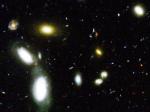 Galaxies in the GOODS
25.06.2003
This tantalizing view of galaxies scattered near and far is part of the Hubble Space Telescope's contribution to the GOODS - the Great Observatories Origins Deep Survey project. The GOODS' goal is to study...
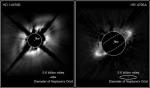 Possible Planets And Infrared Dust
20.01.1999
These near-infrared Hubble images of dust surrounding young stars offer the latest tantalizing evidence for planets beyond our Solar System. At left, the dark gap seen in the dust disk is reminiscent of a similar large gap in Saturn's rings believed to be sculpted by orbiting moons.
|
January February March April May June July August September October |
|||||||||||||||||||||||||||||||||||||||||||||||||