
|
You entered: stars
 Young Stars, Dark Nebulae
10.01.2025
An unassuming region in the constellation Taurus holds these dark and dusty nebulae. Scattered through the scene, stars in multiple star systems are forming within their natal Taurus molecular cloud complex some 450 light-years away.
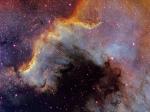 The Cygnus Wall of Star Formation
21.06.2005
The North America Nebula in the sky can do what North Americans on Earth cannot -- form stars. Specifically, in analogy to the Earth-confined continent, the bright part that appears as Central America and Mexico is actually a hot bed of gas, dust, and newly formed stars known as the Cygnus Wall.
 Fire Glow and Star Trails at Sunset Crater
7.07.2005
Stars gracefully arc over the glow from a not too distant forest fire in this dramatic time exposure. A recent camping trip with family and friends to Sunset Crater Volcano National Monument, near Flagstaff, Arizona, USA produced the opportunity to record the subtle lighting from Earth and sky.
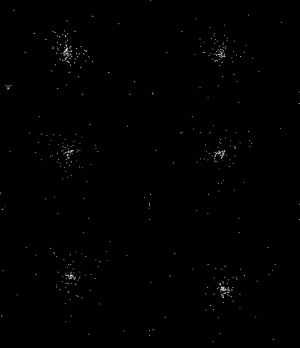 A Star Cluster in Motion
30.07.2002
Star clusters are a swarm of complex motions. The stars that compose globular clusters and many open clusters all orbit the cluster center, occasionally interacting, gravitationally, with a close-passing star. The orbits of stars around the cluster are typically not as circular as the orbits of planets in our solar system.
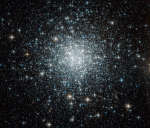 Globular Star Cluster NGC 6934
9.10.2010
Globlular star clusters roam the halo of our Milky Way Galaxy. Gravitationally bound, these spherical groupings of typically several hundred thousand stars are ancient, older than the stars of the galactic disk. In fact...
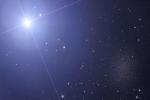 Bright Star Regulus near the Leo 1 Dwarf Galaxy
19.06.2006
The star on the upper left is so bright it is sometimes hard to notice the galaxy on the lower right. Both the star, Regulus, and the galaxy, Leo I, can be found within one degree of each other toward the constellation of Leo.
 M7: Open Star Cluster in Scorpius
13.07.2016
M7 is one of the most prominent open clusters of stars on the sky. The cluster, dominated by bright blue stars, can be seen with the naked eye in a dark sky in the tail of the constellation of the Scorpion (Scorpius).
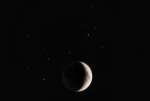 Young Moon and Sister Stars
26.03.2010
A young crescent Moon shares the western sky with sister stars of the Pleiades cluster in this pretty, evening skyscape recorded on the March equinox from San Antonio, Texas. In the processed digital image, multiple exposures of the celestial scene were combined to show details of the bright lunar surface along with the Pleiades stars.
 Bow Tie Moon and Star Trails
8.02.2018
On January 31, a leisurely lunar eclipse was enjoyed from all over the night side of planet Earth, the first of three consecutive total eclipses of the Moon. This dramatic time-lapse image followed the celestial performance for over three hours in a combined series of exposures from Hebei Province in Northern China.
 A Flock of Stars
5.10.2001
Only a few stars can be found within ten light-years of our lonely Sun, situated near an outer spiral arm of the Milky Way galaxy. But if our Sun were found within a star cluster, thousands of stars might occupy a similar space.
|
January February March April May June July August September October |
|||||||||||||||||||||||||||||||||||||||||||||||||