
|
You entered: stars
 Star Party on Planet Earth
4.04.2009
As twilight sweeps around planet Earth tonight (April 4), many amateur astronomers will set up their telescopes for a 24-hour global star party. The planetwide star party is part of 100 Hours of Astronomy (100HA), a project of the International Year of Astronomy 2009.
 Light from the First Stars
1.01.2007
What were the first stars like? No one is yet sure. Our Sun is not a first-generation star. It is not even second generation. The first stars to appear in the universe likely came and went about 13 billion years ago.
 Open Star Cluster M38
6.01.2003
Open cluster M38 can be seen with binoculars toward the constellation of Auriga. M38 is considered an intermediately rich open cluster of stars, each of which is about 200 million years old. Located...
 Old Moon and Sister Stars
29.06.2006
An old crescent Moon shares the eastern sky over Menton, France with the sister stars of the Pleiades cluster in this early morning skyscape recorded just last Friday, June 23rd. (Bright Venus was also...
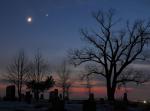 December Moon Meets Evening Star
8.12.2005
If you've been outdoors near sunset, then you've probably noticed Venus low in the west as the brilliant evening star. Sometimes mistaken for a tower light near the horizon, Venus is the third brightest celestial beacon, after the Sun and Moon, in planet Earth's sky.
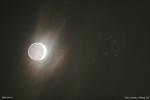 Young Moon and Sister Stars
28.04.2007
A young crescent Moon shared the western sky with thin clouds and the sister stars of the Pleiades cluster in this early evening skyscape recorded on April 19th. Astronomical images of the well-known Pleiades often show the star cluster's alluring blue reflection nebulae, but they are washed-out here in the clouds and bright moonlight.
 Star Factory Messier 17
28.08.2024
A nearby star factory known as Messier 17 lies some 5,500 light-years away in the nebula-rich constellation Sagittarius. At that distance, this 1.5 degree wide field-of-view would span about 150 light-years.
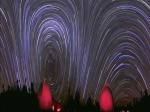 Warped Sky: Star Trails Panorama
13.06.2007
What's happened to the sky? A time warp, of sorts, and a digital space warp too. The time warp occurs because the above image captured in a single frame a four hour exposure of the night sky. Prominent and picturesque star trails are visible.
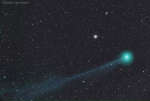 Comet Lovejoy before a Globular Star Cluster
30.12.2014
Comet Lovejoy has become visible to the unaided eye. To see the comet, just go outside an hour or so after sunset and look for a fuzzy patch to the right of Orion's belt. Binoculars and a star chart may help.
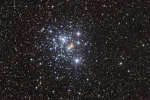 NGC 4755: A Jewel Box of Stars
17.08.2010
The great variety of star colors in this open cluster underlies its name: The Jewel Box. One of the bright central stars is a red supergiant, in contrast to the many blue stars that surround it. The cluster, also known as Kappa Crucis contains just over 100 stars, and is about 10 million years old.
|
January February March April May June July August September October |
|||||||||||||||||||||||||||||||||||||||||||||||||