
|
You entered: stars
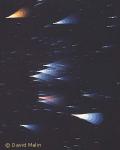 Orion Star Colours
29.08.1998
What determines a star's colour? Its temperature. Red stars are cool, around 3,000 kelvins (K), while blue stars are hotter and can have temperatures over 30,000 K. Our own lovely yellow Sun's temperature is a comforting 6,000 K.
 M7: Open Star Cluster in Scorpius
8.11.2009
M7 is one of the most prominent open clusters of stars on the sky. The cluster, dominated by bright blue stars, can be seen with the naked eye in a dark sky in the tail of the constellation of the Scorpion (Scorpius).
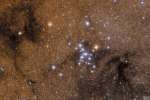 M7: Open Star Cluster in Scorpius
7.01.2014
M7 is one of the most prominent open clusters of stars on the sky. The cluster, dominated by bright blue stars, can be seen with the naked eye in a dark sky in the tail of the constellation of the Scorpion (Scorpius).
 NGC 2244: A Star Cluster in the Rosette Nebula
17.03.2002
In the heart of the Rosette Nebula lies a bright open cluster of stars that lights up the nebula. The stars of NGC 2244 formed from the surrounding gas only four million years ago and emit light and wind that define the nebula's appearance today.
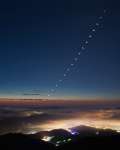 Moon Meets Morning Star
24.08.2012
Rising in the dark hours before dawn, wandering Venus now shines as the brilliant morning star. Its close conjunction with the Moon on August 13 was appreciated around planet Earth. But skygazers in eastern...
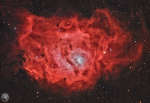 The Lagoon Nebula is Stars, Gas, and Dust
12.11.2018
The majestic Lagoon Nebula is filled with hot gas and the home for many young stars. Spanning 100 light years across while lying only about 5000 light years distant, the Lagoon Nebula is so big and bright that it can be seen without a telescope toward the constellation of the Archer (Sagittarius).
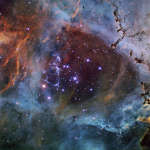 NGC 2244: A Star Cluster in the Rosette Nebula
21.02.2021
In the heart of the Rosette Nebula lies a bright open cluster of stars that lights up the nebula. The stars of NGC 2244 formed from the surrounding gas only a few million years ago.
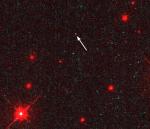 A Lonely Neutron Star
28.11.1998
How massive can a star get without imploding into a black hole? These limits are being tested by the discovery of a lone neutron star in space. Observations by the Hubble Space Telescope have...
 APOD: 2024 December 2 Б NGC 300: A Galaxy of Stars
2.12.2024
This galaxy is unusual for how many stars it seems that you can see. Stars are so abundantly evident in this deep exposure of the spiral galaxy NGC 300 because so many of these stars are bright blue and grouped into resolvable bright star clusters.
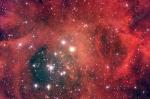 NGC 2244: A Star Cluster in the Rosette Nebula
22.08.2000
In the heart of the Rosette Nebula lies a bright open cluster of stars that lights up the nebula. The stars of NGC 2244 formed from the surrounding gas only four million years ago and emit light and wind that define the nebula's appearance today
|
January February March April May June July August September October |
|||||||||||||||||||||||||||||||||||||||||||||||||