
|
You entered: stars
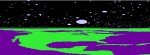 A Star Where Photons Orbit
26.11.1995
The above computer animated picture depicts how a very compact star would look to a nearby observer. The star pictured is actually more compact that any known except a black hole, so it is only hypothetical. The observer is situated at the photon sphere, where photons can orbit in a circle.
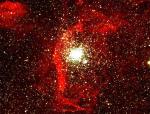 NGC 1850: Gas Clouds and Star Clusters
24.12.2000
There's nothing like it in our own Galaxy. Globular clusters as young as NGC 1850 don't exist here. Globular clusters only 40 millions of years old can still be found in the neighboring LMC galaxy, though, but perhaps none so unusual as NGC 1850.
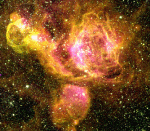 A Star Forming Region in the LMC
23.08.1997
Stars sometimes form in colorful ways. Pictured above is a small region in the nearby LMC galaxy where stars are forming. After a star is born, it may do several things to energize its immediate neighborhood.
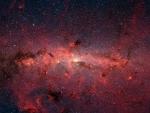 Stars of the Galactic Center
13.01.2006
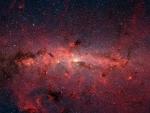
The center of our Milky Way Galaxy is hidden from the prying eyes of optical telescopes by clouds of obscuring dust and gas. But in this stunning vista, the Spitzer Space Telescope's infrared cameras, penetrate much of the dust revealing the stars of the crowded galactic center region.
 Stars of the Galactic Center
10.02.2007
The center of our Milky Way Galaxy is hidden from the prying eyes of optical telescopes by clouds of obscuring dust and gas. But in this stunning vista, the Spitzer Space Telescope's infrared cameras, penetrate much of the dust revealing the stars of the crowded galactic center region.
 Sagittarius Star Cloud
13.01.1999
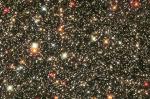
Stars come in all different colors. The color of a star indicates its surface temperature, an important property used to assign each star a spectral type. Most stars in the above Sagittarius Star Cloud are orange or red and relatively faint, as our Sun would appear.
 The Nearest Stars
18.03.2001
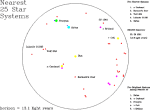
Which stars are closest to the Sun? The closest is Proxima Centauri, one of three stars that orbit each other about 4 light-years away in the Alpha-Centauri system. Alpha Centauri is easily visible from Earth's
 The Nearest Stars
21.04.1999
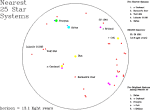
Which stars are closest to the Sun? The closest is Proxima Centauri, one of three stars that orbit each other about 4 light-years away in the Alpha-Centauri system. Alpha Centauri is easily visible from Earth's Southern Hemisphere. Next is Barnard's Star, a dim star visible with a telescope in the constellation of Ophiuchus.
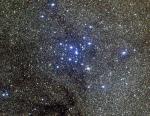 The M7 Open Star Cluster in Scorpius
22.02.2004
M7 is one of the most prominent open clusters of stars on the sky. The cluster, dominated by bright blue stars, can be seen with the naked eye in a dark sky in the tail of the constellation of Scorpius.
 R136: The Massive Stars of 30 Doradus
11.12.2005
In the center of star-forming region 30 Doradus lies a huge cluster of the largest, hottest, most massive stars known. These stars, known as the star cluster R136, and part of the surrounding nebula are captured here in this gorgeous visible-light image from the Hubble Space Telescope.
|
January February March April May June July August September October |
|||||||||||||||||||||||||||||||||||||||||||||||||