
|
You entered: nebula
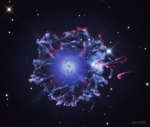 Halo of the Cats Eye
3.08.2022
What created the unusual halo around the Cat's Eye nebula? No one is sure. What is sure is that the Cat's Eye Nebula (NGC 6543) is one of the best known planetary nebulae on the sky.
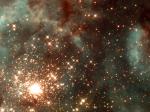 Star Cluster R136 Bursts Out
6.05.2007
In the center of star-forming region 30 Doradus lies a huge cluster of the largest, hottest, most massive stars known. These stars, known as the star cluster R136, and part of the surrounding nebula are captured here in this gorgeous visible-light image from the Hubble Space Telescope.
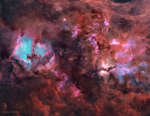 Cygnus Without Stars
30.11.2020
The sky is filled with faintly glowing gas, though it can take a sensitive camera and telescope to see it. For example, this twelve-degree-wide view of the northern part of the constellation Cygnus reveals a complex array of cosmic clouds of gas along the plane of our Milky Way galaxy.
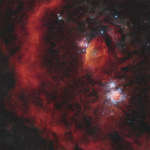 APOD: 2026 February 18 Б Orions Cradle
18.02.2026
Cradled in red-glowing hydrogen gas, stars are being born in Orion. These stellar nurseries lie at the edge of the giant Orion molecular cloud complex, some 1,500 light-years away. This detailed view spans...
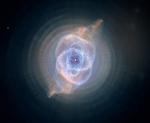 Cat s Eye
10.09.2004
Staring across interstellar space, the alluring Cat's Eye nebula lies three thousand light-years from Earth. A classic planetary nebula, the Cat's Eye (NGC 6543) represents a final, brief yet glorious phase in the life of a sun-like star.
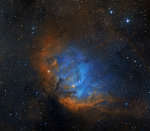 The Tulip in the Swan
20.10.2016
Framing a bright emission region this telescopic view looks out along the plane of our Milky Way Galaxy toward the nebula rich constellation Cygnus the Swan. Popularly called the Tulip Nebula, the glowing cloud of interstellar gas and dust is also found in the 1959 catalog by astronomer Stewart Sharpless as Sh2-101.
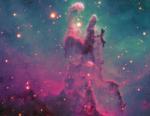 Eagle Castle
30.07.1997
What lights up this castle of star formation? The familiar Eagle Nebula glows much like a neon sign, but in many colors at once. The above photograph is a composite of three of these glowing gas colors.
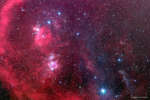 Southern Orion: From Belt to Witch
8.04.2008
Do you recognize the belt of Orion in this image? The familiar trio of stars, visible to the unaided eye, can be found across the upper left. Otherwise, the southern part of the constellation...
 From the Galactic Plane through Antares
2.07.2018
Behold one of the most photogenic regions of the night sky, captured impressively. Featured, the band of our Milky Way Galaxy runs diagonally along the far left, while the colorful Rho Ophiuchus region including...
 The Interstellar Clouds of Orion
5.06.2019
The constellation of Orion is much more than three stars in a row. It is a direction in space that is rich with impressive nebulas. To better appreciate this well-known swath of sky, a new long exposure image was taken over several clear nights in January, February and March.
|
January February March April May June July August |
||||||||||||||||||||||||||||||||||||||||||||||||||||||||