
|
You entered: nebula
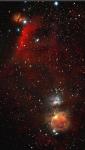 Orion Nebulosities
30.05.2002
Adrift 1,500 light-years away in one of the night sky's most recognizable constellations, the glowing Orion Nebula and the dark Horsehead Nebula are contrasting cosmic vistas. They both appear in this stunning composite color photograph along with other nebulosities as part of the giant Orion Molecular Cloud complex, itself hundreds of light-years across.
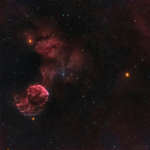 The Jellyfish and Mars
19.05.2021
Normally faint and elusive, the Jellyfish Nebula is caught in this alluring scene. In the telescopic field of view two bright yellowish stars, Mu and Eta Geminorum, stand just below and above the Jellyfish Nebula at the left. Cool red giants, they lie at the foot of the celestial twin.
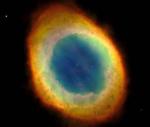 The Ring
7.01.1999
Except for the Rings of Saturn, The Ring Nebula (M57) is probably the most famous celestial band. This planetary nebula's simple, graceful appearance is thought to be due to perspective -- our view from planet Earth looking straight into what is actually a barrel-shaped cloud of gas shrugged off by a dying central star.
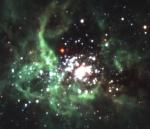 Tarantula
4.06.1997
NGC 2070 is an immense star forming region in a nearby galaxy known as the Large Magellanic Cloud. Its spidery appearance is responsible for its popular name, "The Tarantula Nebula", except that this tarantula is about 1,000 light-years across, and 165,000 light-years away in the southern constellation Dorado.
 Orion and the Running Man
13.11.2025
Few cosmic vistas can excite the imagination like The Great Nebula in Orion. Visible as a faint, bland celestial smudge to the naked-eye, the nearest large star-forming region sprawls across this sharp colorful telescopic image. Designated M42 in the Messier Catalog, the Orion Nebula's glowing gas and dust surrounds hot, young stars.
 Simeis 188 in Stars, Dust and Gas
27.06.2012
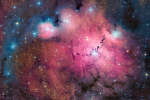
When stars form, pandemonium reigns. A particularly colorful case is the star forming region Simeis 188 which houses an unusual and bright cloud arc cataloged as NGC 6559. Visible above are red glowing emission nebulas of hydrogen, blue reflection nebulas of dust, dark absorption nebulas of dust, and the stars that formed from them.
 M27: Not a Comet
5.10.2024
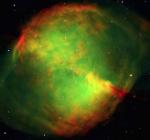
While hunting for comets in the skies above 18th century France, astronomer Charles Messier diligently kept a list of the things encountered during his telescopic expeditions that were definitely not comets. This is number 27 on his now famous not-a-comet list.
 Alnitak, Alnilam, Mintaka
20.11.2025
Alnitak, Alnilam, and Mintaka are the bright bluish stars from east to west (upper right to lower left) along the diagonal in this cosmic vista. Otherwise known as the Belt of Orion, these three blue supergiant stars are hotter and much more massive than the Sun.
 M27: Not A Comet
2.03.2002
While searching the skies above 18th century France for comets, astronomer Charles Messier diligently recorded this object as number 27 on his list of things which are definitely not comets. So what is it?
 Field of Rosette
14.02.2010
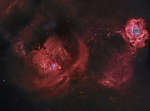
What surrounds the florid Rosette nebula? To better picture this area of the sky, the famous flowery emission nebula on the far right has been captured recently in a deep and dramatic wide field image that features several other sky highlights.
|
January February March April May June July August |
||||||||||||||||||||||||||||||||||||||||||||||||||||||||