
|
You entered: nebula
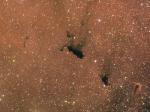 Molecular Cloud Barnard 163
21.03.2007
It may look to some like a duck, but it lays stars instead of eggs. In the center of the above image lies Barnard 163, a nebula of molecular gas and dust so thick that visible light can't shine through it.
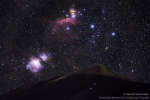 Orions Belt and Sword over Teides Peak
28.03.2016
The southern part of Orion, the famous constellation and mythical hunter, appears quite picturesque posing here over a famous volcano. Located in the Canary Islands off the northwest coast of Africa, the snow-peaked Teide is one of the largest volcanoes on Earth.
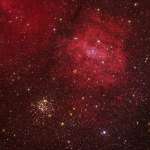 The Bubble and M52
30.10.2009
To the eye, this cosmic composition nicely balances the Bubble Nebula at the upper right with open star cluster M52. The pair would be lopsided on other scales, though. Embedded in a complex...
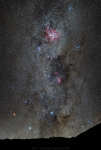 The Southern Cross in a Southern Sky
19.10.2015
Have you ever seen the Southern Cross? This famous constellation is best seen from Earth's Southern Hemisphere. Captured from Rio de Janeiro, Brazil, the four bright stars that mark the Southern Cross are visible just above the horizon in the featured image.
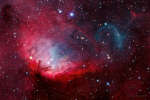 The Tulip and Cygnus X 1
16.02.2017
Framing a bright emission region, this telescopic view looks out along the plane of our Milky Way Galaxy toward the nebula rich constellation Cygnus the Swan. Popularly called the Tulip Nebula, the reddish glowing cloud of interstellar gas and dust is also found in the 1959 catalog by astronomer Stewart Sharpless as Sh2-101.
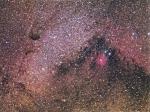 M24: A Sagittarius Starscape
21.09.2004
Many vast star fields in the plane of our Milky Way Galaxy are rich in clouds of dust, and gas. First and foremost, visible in the above picture are millions of stars, many of which are similar to our Sun.
 APOD: 2025 April 16 Б Halo of the Cats Eye
16.04.2025
What created the unusual halo around the Cat's Eye Nebula? No one is sure. What is sure is that the Cat's Eye Nebula (NGC 6543) is one of the best known planetary nebulae on the sky.
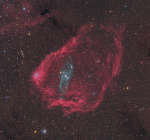 A Giant Squid in the Flying Bat
11.09.2015
Very faint but also very large on planet Earth's sky, a giant Squid Nebula cataloged as Ou4, and Sh2-129 also known as the Flying Bat Nebula, are both caught in this scene toward the royal constellation Cepheus.
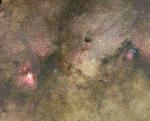 APOD: 2002 September 18- A Sagittarius Starscape
18.09.2002
Many vast star fields in the plane of our Milky Way Galaxy are rich in clouds of stars, dust, and gas. First and foremost, visible in the above picture are millions of stars, many of which are similar to our Sun.
 APOD: 2025 August 4 Б Blue Arcs Toward Andromeda
4.08.2025
What are these gigantic blue arcs near the Andromeda Galaxy (M31)? Discovered in 2022 by amateur astronomers, the faint arcs -- dubbed SDSO 1 -- span nearly the same angular size as M31 itself. At first, their origin was a mystery: are they actually near the Andromeda Galaxy, or alternatively near to our Sun?
|
January February March April May June July August |
||||||||||||||||||||||||||||||||||||||||||||||||||||||||