
|
You entered: jet
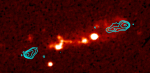 An Energetic Radio Galaxy
30.09.1995
The radio and optical emission seen in the above superposed images of the radio galaxy 3C368 indicate that energetic processes are at work. A radio galaxy is a galaxy that is visible to radio telescopes. A large radio signal usually indicates very powerful phenomena.
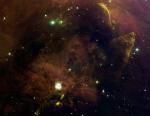 A Panorama of Oddities in Orion A
13.03.2000
New stars, fast jets, and shocked gas clouds all occupy Orion A, a giant molecular cloud just south of the Orion Nebula. The bright object visible below and slightly left of center of this recently released picture is the reflection nebula NGC 1999.
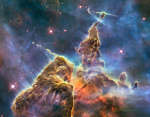 Dust Pillar of the Carina Nebula
26.04.2010
Inside the head of this interstellar monster is a star that is slowly destroying it. The monster, on the right, is actually an inanimate pillar of gas and dust that measures over a light year in length.
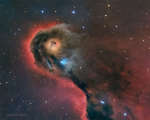 APOD: 2025 October 14 Б An Unusual Globule in IC 1396
14.10.2025
Is there a monster in IC 1396? Known to some as the Elephant's Trunk Nebula, parts of gas and dust clouds of this star formation region may appear to take on foreboding forms, some nearly human. The only real monster here, however, is a bright young star too far from Earth to hurt us.
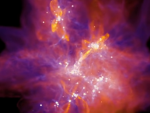 STARFORGE: A Star Formation Simulation
23.06.2021
How do stars form? Most form in giant molecular clouds located in the central disk of a galaxy. The process is started, influenced, and limited by the stellar winds, jets, high energy starlight, and supernova explosions of previously existing stars.
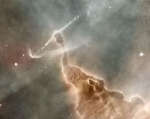 Dust Pillar of the Carina Nebula
24.03.2013
Inside the head of this interstellar monster is a star that is slowly destroying it. The monster, actually an inanimate pillar of gas and dust, measures over a light year in length. The star, not itself visible through the opaque dust, is bursting out partly by ejecting energetic beams of particles.
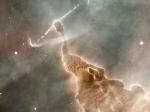 Dust Pillars of the Carina Nebula
30.04.2007
Inside the head of this interstellar monster is a star that is slowly destroying it. The monster, actually an inanimate pillar of gas and dust, measures over a light year in length. The star, not itself visible through the opaque dust, is bursting out partly by ejecting energetic beams of particles.
 Ida and Dactyl: Asteroid and Moon
30.06.1995
An asteroid with a moon! The robot spacecraft Galileo whose primary mission is to explore the Jupiter system, has encountered and photographed two asteroids during its long journey to Jupiter. The second asteroid...
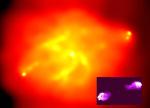 X Ray Cygnus A
10.11.2000
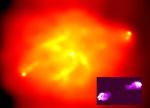
Amazingly detailed, this false-color x-ray image is centered on the galaxy Cygnus A. Recorded by the orbiting Chandra Observatory, Cygnus A is seen here as a spectacular high energy x-ray source. But it is actually more famous at the low energy end of the electromagnetic spectrum as one of the brightest celestial radio sources.
 X Ray Cygnus A
5.10.2002
Amazingly detailed, this false-color x-ray image is centered on the galaxy Cygnus A. Recorded by the orbiting Chandra Observatory, Cygnus A is seen here as a spectacular high energy x-ray source. But it is actually more famous at the low energy end of the electromagnetic spectrum as one of the brightest celestial radio sources.
|
January February March April May June July August September |
|||||||||||||||||||||||||||||||||||||||||||||||||