
|
You entered: jet
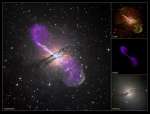 Active Galaxy Centaurus A
9.01.2008
A mere 11 million light-years away, Centaurus A is a giant elliptical galaxy - the closest active galaxy to Earth. This remarkable composite view of the galaxy combines image data from the x-ray ( Chandra), optical(ESO), and radio(VLA) regimes.
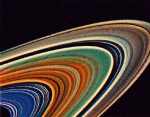 The Rings of Saturn
30.07.1995
Saturn's spectacular system of bright rings has been the subject of study and wonder since Galileo first turned his telescope on the ringed planet in 1610. To Galileo, the blurry image produced by his small telescope was confusing. Saturn appeared to him to have "ear-like" appendages which he thought might be large moons.
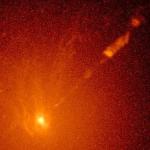 A Black Hole in M87?
5.04.1997
The center of nearby giant galaxy M87 is a dense and violent place. In this 1994 photograph by the Hubble Space Telescope, a disk of hot gas was found to be orbiting at the center of this massive elliptical galaxy. The disk is evident at the lower left of the picture.
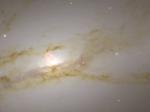 A Bubbling Galaxy Center
12.06.2000
What's happening in the center of this galaxy? Close inspection of the center of NGC 4438, as visible in this recently released representative-color image by the Hubble Space Telescope, reveals an unusual bubble of hot gas, colored in red.
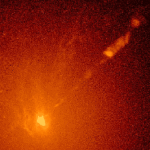 A Black Hole in M87's Center?
4.03.1996
The center of nearby giant galaxy M87 is a dense and violent place. In this 1994 photograph by the Hubble Space Telescope, a disk of hot gas was found to be orbiting at the center of this massive elliptical galaxy. The disk is evident on the lower left of the above photograph.
 Jupiter from Voyager
25.06.1995
Imagine a hurricane that lasted for 300 years! This picture of the planet Jupiter was taken by the Voyager 1 spacecraft as it passed the planet in 1979. Jupiter, a gas giant planet with no solid surface, is the largest planet in the solar system and is made mostly of the hydrogen and helium.
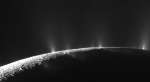 Cassini Flyby Shows Enceladus Venting
23.11.2009
What's happening on the surface of Saturn's moon Enceladus? Enormous ice jets are erupting. Giant plumes of ice have been photographed in dramatic fashion by the robotic Cassini spacecraft during this past weekend's flyby of Saturn's moon Enceladus.
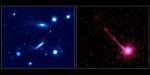 PKS 1127 145: Quasar View
7.02.2002
The quasar known as PKS 1127-145 lies ten billion light-years from our fair planet. A Hubble Space Telescope view in the left panel shows this quasar along with other galaxies as they appear in optical light. The quasar itself is the brightest object in the lower right corner.
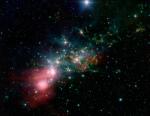 Dusty NGC 1333
23.11.2005
Dusty NGC 1333 is seen as a reflection nebula in visible light images, sporting bluish hues characteristic of starlight reflected by dust. But at longer infrared wavelengths, the interstellar dust itself glows - shown in red in this false-color Spitzer Space Telescope image.
 The Large and Small of M87
15.02.1999
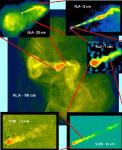
The small core of elliptical galaxy M87 appears to be energizing its whole galactic neighborhood. Recent images from the Very Large Array (VLA) of radio telescopes indicate that huge bubbles of hot gas not only exist but are still being created. These bubbles measure 200,000 light-years across and surround the entire galaxy.
|
January February March April May June July August September |
|||||||||||||||||||||||||||||||||||||||||||||||||