
|
You entered: jet
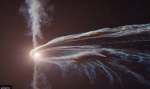 Animation: Black Hole Star Shredder
27.04.2021
What happens if a star gets too close to a black hole? The black hole can rip it apart -- but how? It's not the high gravitational attraction itself that's the problem -- it's the difference in gravitational pull across the star that creates the destruction.
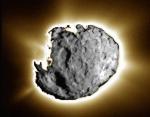 Going Wild
19.03.2004
Dynamic jets of gas and dust surround one of the most active planetary surfaces in the solar system in this wild-looking picture of a comet nucleus. The comet's designation is 81P/Wild...
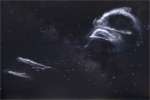 Rocket Trails in the Milky Way
29.03.2012
On March 27, five sounding rockets leapt into early morning skies from NASA's Wallops Flight Facility in Virginia. Part of the Anomalous Transport Rocket EXperiment (ATREX), begining at 4:58 am EDT the rockets launched consecutively at 80 second intervals.
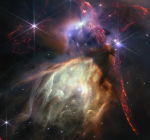 Webb's Rho Ophiuchi
25.10.2025
A mere 390 light-years away, Sun-like stars and future planetary systems are forming in the Rho Ophiuchi molecular cloud complex, the closest star-forming region to our fair planet. The James Webb Space Telescope's NIRCam peered into the nearby natal chaos to capture this infrared image at an inspiring scale.
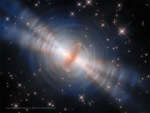 APOD: 2026 February 25 Б The Egg Nebula from the Hubble Telescope
25.02.2026
Ever wonder what it would look like to crack open the Sun? The Egg Nebula, a dying Sun-like star, can unscramble this question. Pictured is a combination of several visible and infrared images of the nebula (also known as RAFGL 2688 or CRL 2688) taken with the Hubble Space Telescope.
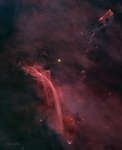 APOD: 2025 December 31 Б HH 222: The Waterfall Nebula
31.12.2025
What created the Waterfall Nebula? The origin is still being researched. The structure, officially designated Herbig-Haro 222, appears in the region of NGC 1999 in the Great Orion Molecular Cloud complex. The elongated gaseous stream stretches about ten light years but appears similar to a long waterfall on Earth.
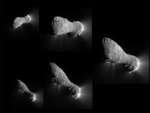 Comet Hartley 2 Flyby
5.11.2010
Follow these 5 frames clockwise starting from the top left to track the view from the EPOXI mission spacecraft as it approached, passed under, and then looked back at the nucleus of comet Hartley 2 on November 4. Its closest approach distance was about 700 kilometers.
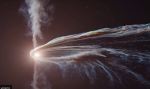 APOD: 2024 June 16 Б Animation: Black Hole Destroys Star
16.06.2024
What happens if a star gets too close to a black hole? The black hole can rip it apart -- but how? It's not the high gravitational attraction itself that's the problem -- it's the difference in gravitational pull across the star that creates the destruction.
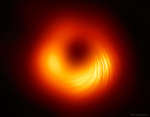 M87s Central Black Hole in Polarized Light
31.03.2021
To play on Carl SaganБs famous words "If you wish to make black hole jets, you must first create magnetic fields." The featured image represents the detected intrinsic spin direction (polarization) of radio waves. The polarizationi is produced by the powerful magnetic field surrounding the supermassive black hole at the center of elliptical galaxy M87.
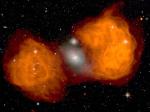 The Giant Radio Lobes of Fornax A
28.06.2005
Together, the radio lobes span over one million light years -- what caused them? In the center is a large but peculiar elliptical galaxy dubbed NGC 1316. Detailed inspection of the NGC 1316 system indicates that it began absorbing a small neighboring galaxy about 100 million years ago.
|
January February March April May June July August September |
|||||||||||||||||||||||||||||||||||||||||||||||||