
|
You entered: Earth
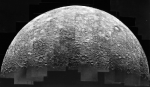 Mercury: A Cratered Inferno
12.09.1996
Mercury's surface looks similar to our Moon's. Each is heavily cratered and made of rock. Mercury's diameter is about 4800 km, while the Moon's is slightly less at about 3500 km (compared with about 12,700 km for the Earth). But Mercury is unique in many ways.
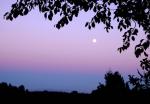 Shadow Rise
22.08.2003
As the Sun sets, the Earth's shadow rises up from the east. The subtle beauty of this daily apparition is often overlooked in favor of the brighter, more colorful western horizon. But while...
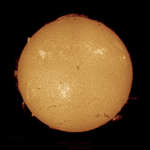 Perihelion Sun 2023
14.01.2023
Perihelion for 2023, Earth's closest approach to the Sun, was on January 4 at 16:17 UTC. That was less than 24 hours after this sharp image of the Sun's disk was recorded with telescope and H-alpha filter from Sidney, Australia, planet Earth.
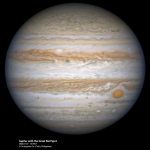 Jupiter with the Great Red Spot
10.01.2026
Jupiter reaches its 2026 opposition today, January 10. That puts our Solar System's most massive planet opposite the Sun and near its closest and brightest for viewing from planet Earth. In fact, captured...
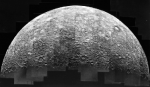 Mercury: A Cratered Inferno
30.11.1997
Mercury's surface looks similar to our Moon's. Each is heavily cratered and made of rock. Mercury's diameter is about 4800 km, while the Moon's is slightly less at about 3500 km (compared with about 12,700 km for the Earth). But Mercury is unique in many ways.
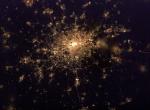 London at Night
11.04.2003
Do you recognize this intriguing globular cluster of stars? It's actually the constellation of city lights surrounding London, England, planet Earth, as recorded with a digital camera from the International Space Station. Taken in February 2003, north is toward the top and slightly left in this nighttime view.
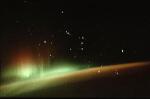 Aurora and Orion
26.01.1997
Looking toward the south from low Earth orbit, the crew of the Space Shuttle Endeavor made this stunning time exposure of the Aurora Australis or southern lights in April of 1994. Aurora are visible at high northern latitudes as well, with the northern lights known as Aurora Borealis.
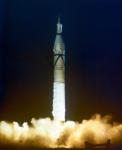 The First Explorer
12.08.2006
Inaugurating the era of space exploration for the US, the First Explorer, a thirty pound satellite, was launched into Earth orbit on February 1, 1958 by the Army Ballistic Missle Agency. Explorer I carried instruments to measure temperatures, micrometeorite impacts, and an experiment designed by James A.
 Sharp Silhouette
21.09.2006
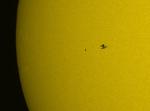
Though it's 93 million miles away, the Sun still hurts your eyes when you look at it. But bright sunlight (along with accurate planning and proper equipment!) resulted in this sharp silhouette of spaceship and space station.
 Moon and Mars Tonight
23.12.2007
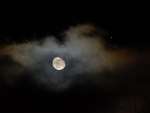
The Full Moon and a brilliant, ruddy Mars will share the sky tonight. Skygazers can easily enjoy the celestial pairing as the two are separated by a degree or even less. In fact, seen from parts of northern North America and Europe, the Moon will actually occult (pass in front of) the Red Planet.
|
January February March April May June July August September October |
|||||||||||||||||||||||||||||||||||||||||||||||||