
|
You entered: Earth
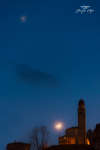 Venus and the Da Vinci Glow
25.03.2023
On March 23 early evening skygazers could watch Venus and a young crescent moon, both near the western horizon. On that date Earth's brilliant evening star, faint lunar night side and slender sunlit crescent were captured in this telephoto skyscape posing alongside a church tower from Danta di Cadore, Dolomiti, Italy.
 APOD: 2025 July 7 Б Interstellar Comet 3I ATLAS
7.07.2025
It came from outer space. An object from outside our Solar System is now passing through at high speed. Classified as a comet because of its gaseous coma, 3I/ATLAS is only the third identified macroscopic object as being so alien.
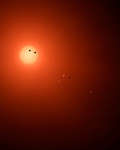 Seven Worlds for TRAPPIST 1
23.02.2017
Seven worlds orbit the ultracool dwarf star TRAPPIST-1, a mere 40 light-years away. In May 2016 astronomers using the Transiting Planets and Planetesimals Small Telescope (TRAPPIST) announced the discovery of three planets in the TRAPPIST-1 system.
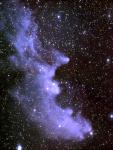 The Witch Head Nebula
27.02.2001
Double, double toil and trouble; Fire burn, and cauldron bubble -- maybe Macbeth should have consulted the Witch Head Nebula. This suggestively shaped reflection nebula is associated with the bright star Rigel in the constellation Orion.
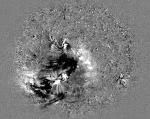 The Sun Puffs
11.04.1997
The Earth has once again endured a burst of particles from the Sun. The latest storm, which began Monday, was one of the best documented solar storms to date. At 10 am (EDT) ground...
 An Anomalous SETI Signal
6.02.2011
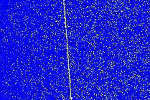
No one knows for sure what caused this signal. There is a slight possibility that it just might originate from an extraterrestrial intelligence. The bright colors on the blue background indicate that an anomalous signal was received here on Earth by a radio telescope involved in a Search for Extraterrestrial Intelligence (SETI).
 Martian Sunset
2.03.2014
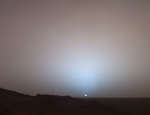
What would it be like to see a sunset on Mars? To help find out, the robotic rover Spirit was deployed in 2005 to park and watch the Sun dip serenely below the distant lip of Gusev crater.
 Habitable Worlds
3.03.2014
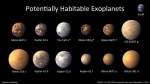
Is Earth the only known world that can support life? In an effort to find life-habitable worlds outside our Solar System, stars similar to our Sun are being monitored for slight light decreases that indicate eclipsing planets. Many previously-unknown planets are being found, including over 700 worlds recently uncovered by NASA's Kepler satellite.
 Comet Meets Moon and Morning Star
12.12.2015
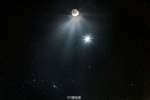
A crescent Moon and brilliant Venus met in predawn skies on December 7, a beautiful conjunction of planet Earth's two brightest celestial beacons after the Sun. Harder to see but also on the scene was Comet Catalina (C/2013 US10).
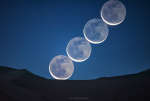 Da Vinci Rise
26.09.2019
An old Moon rose this morning, its waning sunlit crescent shining just above the eastern horizon before sunrise. But earthshine, light reflected from a bright planet Earth, lit the shadowed portion of the lunar disk and revealed most of a familiar lunar near side to early morning risers.
|
January February March April May June July August September October |
|||||||||||||||||||||||||||||||||||||||||||||||||