
|
You entered: Earth
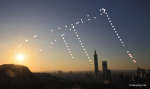 Analemma over Taipei
21.06.2022
Does the Sun return to the same spot on the sky every day? No. A better and more visual answer to that question is an analemma, a composite of images taken at the same time and from the same place over the course of a year.
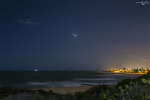 APOD: 2023 March 5 Б Jupiter and Venus over Italy
5.03.2023
What are those two bright spots? Planets. A few days ago, the two brightest planets in the night sky passed within a single degree of each other in what is termed a conjunction. Visible just after sunset in much of the world, the two bright spots were Jupiter (left) and Venus (right).
 Sky Full of SARs
17.08.2024
On August 11 a Rocket Lab Electron rocket launched from a rotating planet. With a small satellite on board its mission was dubbed A Sky Full of SARs (Synthetic Aperture Radar satellites), departing for low Earth orbit from Mahia Peninsula on New Zealand's north island.
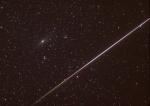 Island Universe, Cosmic Sand
23.08.2002
On August 13, while counting Perseid meteors under dark, early morning Arizona skies, Rick Scott set out to photograph their fleeting but fiery trails. The equipment he used included a telephoto lens and fast color film. After 21 pictures he'd caught only two meteors, but luckily this was one of them.
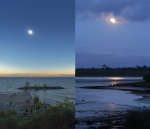 August Moons
21.08.2008
This August was eclipse season. The month's first New Moon and Full Moon were both seen in darkened skies during a solar and lunar eclipse. Blocking the Sun, the left panel...
 Gamma rays and Comet Dust
20.08.2016
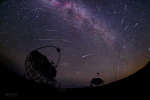
Gamma-rays and dust from periodic Comet Swift-Tuttle plowed through planet Earth's atmosphere on the night of August 11/12. Impacting at about 60 kilometers per second the grains of comet dust produced this year's remarkably active Perseid meteor shower.
 Earthset from Orion
24.01.2026
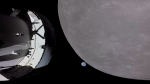
Eight billion people are about to disappear in this snapshot from space taken on 2022 November 21. On the sixth day of the Artemis I mission, their home world is setting behind the Moon's bright edge as viewed by an external camera on the outbound Orion spacecraft.
 Southwest Mercury
13.09.1996
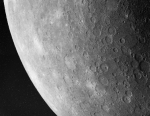
The planet Mercury resembles a moon. Mercury's old surface is heavily cratered like many moons. Mercury is larger than most moons but smaller than Jupiter's moon Ganymede and Saturn's moon Titan. Mercury is much denser and more massive than any moon, though, because it is made mostly of iron.
 Moonrise Through Mauna Keas Shadow
3.12.2003
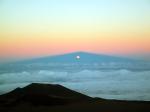
How can the Moon rise through a mountain? It cannot -- what was photographed here is a moonrise through the shadow of a large volcano. The volcano is Mauna Kea, Hawai'i, USA, a frequent spot for spectacular photographs since it is arguably the premier observing location on planet Earth.
 The Equal Night
20.03.2005
Today, the Sun crosses the celestial equator heading north, marking the Vernal Equinox -- the first day of spring in the Northern Hemisphere and autumn in the south. Equinox means equal night and with the Sun on the celestial equator, Earthlings will experience 12 hours of daylight and 12 hours of darkness.
|
January February March April May June July August September October |
|||||||||||||||||||||||||||||||||||||||||||||||||