
|
You entered: Earth
 APOD: 2024 August 27 Б Moon Eclipses Saturn
27.08.2024
What if Saturn disappeared? Sometimes, it does. It doesn't really go away, though, it just disappears from view when our Moon moves in front. Such a Saturnian eclipse, more formally called an occultation, was visible along a long swath of Earth -- from Peru, across the Atlantic Ocean, to Italy -- only a few days ago.
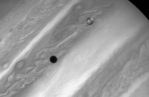 Io's Shadow
7.10.1996
Caught in the act earlier this summer by the Hubble Space Telescope, the volcanic moon Io (above and right of center) and its shadow (black dot) are seen here against Jupiter's clouds.
 Himalayan Horizon From Space
28.05.2005
This stunning aerial view shows the rugged snow covered peaks of a Himalayan mountain range in Nepal. The seventh-highest peak on the planet, Dhaulagiri, is the high point on the horizon at the left while in the foreground lies the southern Tibetan Plateau of China.
 APOD: 2023 August 1 Б Monster Solar Prominence
1.08.2023
The monsters that live on the Sun are not like us. They are larger than the Earth and made of gas hotter than in any teapot. They have no eyes, but at times, many tentacles. They float. Usually, they slowly change shape and just fade back onto the Sun over about a month.
 APOD: 2025 February 5 Б Comet G3 ATLAS Setting over a Chilean Hill
5.02.2025
Where is Comet ATLAS going? In the featured time-lapse video, the comet is not itself moving very much, but the Earth's rotation makes it appear to be setting over a hill. The Comet C/2024 G3 (ATLAS) sequence was captured with an ordinary camera on January 22 from the Araucanцa Region in central Chile.
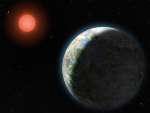 Zarmina s World
1.10.2010
A mere 20 light-years away in the constellation Libra, red dwarf star Gliese 581 has received much scrutiny by astronomers in recent years. Earthbound telescopes had detected the signatures of multiple planets orbiting...
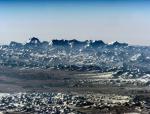 Himalayan Horizon From Space
26.12.2001
This stunning aerial view shows the rugged snow covered peaks of a Himalayan mountain range in Nepal. The seventh-highest peak on the planet, Dhaulagiri, is the high point on the horizon at the left while in the foreground lies the southern Tibetan Plateau of China.
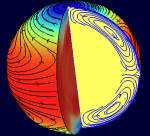 Rivers in the Sun
4.09.1997
The surface of the Sun is shifting. By watching sunspots, it has long been known that our Sun rotates. It was also known that the center of the Sun rotates faster than the poles.
 Mercury Meets Crescent Venus
29.05.2020
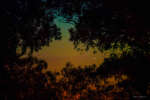
That's not a bright star and crescent Moon caught between branches of a eucalyptus tree. It's Venus in a crescent phase and Mercury. Near the western horizon after sunset, the two inner planets closely shared this telescopic field of view on May 22, seen from a balcony in Civitavecchia, Italy.
 Zodiacal Night
10.04.2021
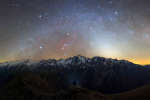
An intense band of zodiacal light is captured in this serene mountain and night skyscape from April 7. The panoramic view was recorded after three hours of hiking from a vantage looking west after sunset across the Pyrenees in southern France. At 2838 meters altitude, Mont Valier is the tallest peak near center.
|
January February March April May June July August September October |
|||||||||||||||||||||||||||||||||||||||||||||||||