
|
You entered: space
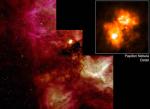 N159 and the Papillon Nebula
14.06.1999
In a search for massive stars, the Hubble Space Telescope has peered into yet another spectacular region of star formation. This nebula, known as N159, spans over 150 light-years and is located in the neighboring Large Magellanic Cloud galaxy, about 170,000 light years distant.
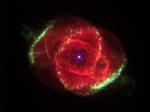 The Cats Eye Nebula
12.11.2006
Three thousand light-years away, a dying star throws off shells of glowing gas. This image from the Hubble Space Telescope reveals the Cat's Eye Nebula to be one of the most complex planetary nebulae known.
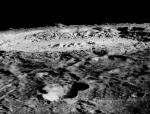 Lunar Orbiter Views Crater Copernicus
16.06.2007
To prepare for the Apollo landings, five Lunar Orbiter spacecraft were launched during 1966 and 1967 to gather detailed images of our fair planet's large, natural satellite. Dramatic views returned by the spacecraft cameras included this stark moonscape.
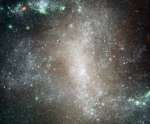 The Star Clusters of NGC 1313
7.08.2009
Like grains of sand on a cosmic beach, individual stars of barred spiral galaxy NGC 1313 are resolved in this sharp composite from the Hubble Space Telescope's Advanced Camera for Surveys (ACS). The inner region of the galaxy is pictured, spanning about 10,000 light-years.
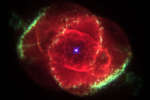 The Cats Eye Nebula
27.12.2009
Three thousand light-years away, a dying star throws off shells of glowing gas. This image from the Hubble Space Telescope reveals the Cat's Eye Nebula to be one of the most complex planetary nebulae known.
 Young Stars, Stellar Jets
28.07.2023
High-speed outflows of molecular gas from a pair of actively forming young stars shine in infrared light, revealing themselves in this NIRcam image from the James Webb Space Telescope. Cataloged as HH (Herbig-Haro) 46/47, the young stars are lodged within a dark nebula that is largely opaque when viewed in visible light.
 APOD: 2023 October 25 Б Gone in 60 Seconds: A Green Flash Sunset
25.10.2023
In 60 seconds, this setting Sun will turn green. Actually, the top of the Sun already appears not only green, but wavey -- along with all of its edges. The Sun itself is unchanged -- both effects are caused by looking along hot and cold layers in Earth's atmosphere.
 Neptune at Night
9.11.2024
Ice giant Neptune is faint in Earth's night sky. Some 30 times farther from the Sun than our fair planet, telescopes are needed to catch a glimpse of the dim and distant world. This dramatic view of Neptune's night just isn't possible for telescopes in the vicinity of planet Earth though.
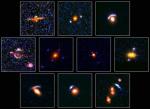 A Gallery of Gravitational Mirages
1.06.1999
The deeper you peer into the universe, the harder it is to see straight. The reason is that distant galaxies act as gravitational lenses, deflecting light that passes nearby. These deflections result in the distortion of background sources, and in some cases the creation of multiple images.
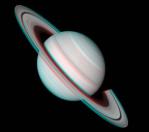 Stereo Saturn
7.09.2002
Get out your red/blue glasses and launch yourself into this stereo picture of Saturn! The picture is actually composed from two images recorded weeks apart by the Voyager 2 spacecraft during its visit to the Saturnian System in August of 1981.
|
January February March April May June July August September October |
|||||||||||||||||||||||||||||||||||||||||||||||||