
|
You entered: space
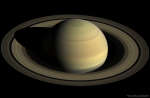 Saturn from Above
25.09.2016
This image of Saturn could not have been taken from Earth. No Earth based picture could possibly view the night side of Saturn and the corresponding shadow cast across Saturn's rings. Since Earth is much closer to the Sun than Saturn, only the day side of the ringed planet is visible from the Earth.
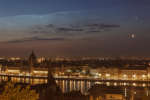 Solstice Conjunction over Budapest
23.06.2017
Before a solstice Sun rose on June 21, brilliant Venus and an old crescent Moon posed together over Budapest, Hungary for this predawn skyscape. In the foreground the view looks across the Danube river from Buda to Pest toward the dome and peaks of the Hungarian Parliament building.
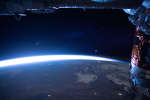 Comet NEOWISE from the ISS
10.07.2020
Rounding the Sun on July 3rd and currently headed for the outer Solar System, Comet NEOWISE (C/2020 F3) has been growing brighter in the predawn skies of planet Earth. From low Earth orbit...
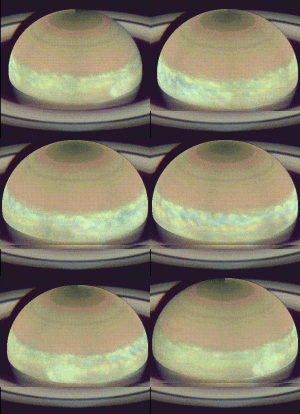 Saturn Rotates
3.10.2000
The dramatic rotation of the cloud-tops of Saturn every ten-hours is particularly evident from orbit around the gas giant planet. With a good enough telescope, however, such rotation is visible even from Earth, as shown by this time-lapse image sequence from the Hubble Space Telescope taken in November 1990.
 Stereo Saturn
29.10.1997
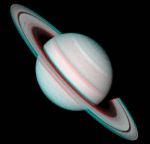
Get out your red/blue glasses and launch yourself into this stereo picture of Saturn! The picture is actually composed from two images recorded weeks apart by the Voyager 2 spacecraft during its visit to the Saturnian System in August of 1981.
 Light from a Extra Solar Planet
5.04.2005
Light emitted by a planet far beyond our Solar System has been identified for the first time. The planet, illustrated in the above drawing, had its light detected by comparing the brightness of only...
 Breaking Distant Light
20.09.2020
In the distant universe, time appears to run slowly. Since time-dilated light appears shifted toward the red end of the spectrum (redshifted), astronomers are able to use cosmological time-slowing to help measure vast distances in the universe.
 APOD: 2024 March 24 Б Looking Back at an Eclipsed Earth
24.03.2024
Here is what the Earth looks like during a solar eclipse. The shadow of the Moon can be seen darkening part of Earth. This shadow moved across the Earth at nearly 2000 kilometers per hour.
 A July Dawn
7.08.2001
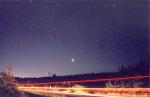
Those up before dawn in late July in the northern hemisphere could see planets, stars, and a spacecraft in a single quick glance before starting their day. Near the eastern horizon was bright Jupiter, and not far above and to its right was the very bright Venus.
 Tanks for the Lift
24.02.1996
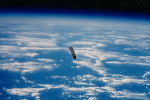
Sixteen minutes after the liftoff of STS-29, the Space Shuttle Discovery's jettisoned External Tank (ET) is seen here, in a photograph by shuttle astronaut James P. Bagian, falling back towards Earth. The 154 foot long ET is the largest non-reusable component in the Shuttle system.
|
January February March April May June July August September October |
|||||||||||||||||||||||||||||||||||||||||||||||||