
|
You entered: space
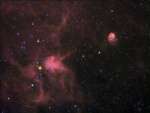 The Spider and the Fly
13.01.2010
Bright clusters and nebulae abound in the ancient northern constellation of Auriga. The region includes the open star cluster M38, emission nebula IC 410 with Tadpoles, Auriga's own Flaming Star Nebula IC 405, and this interesting pair IC 417 (lower left) and NGC 1931.
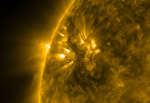 Dark Filament of the Sun
22.05.2010
Suspended by magnetic fields above a solar active region this dark filament stretches over 40 earth-diameters. The ominous structure appears to be frozen in time near the Sun's edge, but solar filaments are unstable and often erupt.
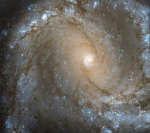 In the Center of Spiral Galaxy M61
20.05.2014
M61 is a barred spiral galaxy located in the nearby Virgo Cluster of Galaxies. Visible in M61 are a host of features common to spiral galaxies: bright spiral arms, a central bar, dust lanes, and bright knots of stars. M61, also known as NGC 4303, in similar to our own Milky Way Galaxy.
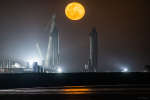 Moon Rising Between Starships
22.02.2021
What's that on either side of the Moon? Starships. Specifically, they are launch-and-return reusable rockets being developed by SpaceX to lift cargo and eventually humans from the Earth's surface into space.
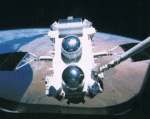 The Compton Gamma Ray Observatory
11.08.1995
The Compton Gamma Ray Observatory (CGRO) was the most massive instrument ever launched by a NASA Space Shuttle and continues to revolutionize gamma-ray astronomy. This orbiting observatory sees the sky in gamma-ray photons - light so blue humans can't see it.
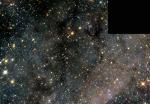 A Magellanic Starfield
4.01.2003
Stars of many types and colors are visible in this Hubble Space Telescope close-up of a starfield in the Large Magellanic Cloud (LMC). Over 10,000 stars are visible -- the brightest of which are giant stars. Were our Sun at the distance of these stars, about 170,000 light-years, it would hardly be discernable.
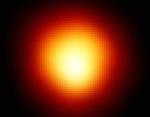 Betelgeuse
19.04.1998
Here is the first direct picture of the surface of a star other than our Sun. Taken by the Hubble Space Telescope in 1995, the atmosphere of Betelgeuse reveals some unexpected features, including a large bright hotspot visible below the center.
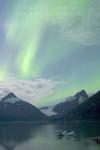 Aurora Over the Chugach Mountains
29.09.2003
Auroras can make spectacular sights. Photographed above, flowing green auroras help the Moon illuminate the serene Portage Lake and the snowy Chugach Mountains near Anchorage, Alaska, USA. Although auroras might first appear to be moonlit clouds, they only add light to the sky and do not block background stars from view.
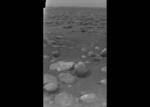 Huygens Images Titan s Surface
15.01.2005
After a seven year interplanetary voyage on board the the Cassini spacecraft, the European Space Agency's Huygens probe parachuted to a historic landing on Saturn's moon Titan on January 14. Above...
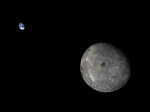 Moon and Earth from Chang e 5 T1
3.11.2014
Described at times as a big blue marble, from some vantage points Earth looks more like a small blue marble. Such was the case in this iconic image of the Earth and Moon system taken by the Chang'e 5-T1 mission last week.
|
January February March April May June July August September October |
|||||||||||||||||||||||||||||||||||||||||||||||||