
|
You entered: space
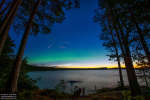 Perseid, Aurora, and Noctilucent Clouds
11.08.2016
Night skies over northern Sweden can hold some tantalizing sights in August. Gazing toward the Big Dipper, this beautiful northern skyscape captures three of them in a single frame taken last August 12/13. Though receding from northern skies for the season, night shining or noctilucent clouds are hanging just above the horizon.
 M100: A Grand Design Spiral Galaxy
25.12.2018
Majestic on a truly cosmic scale, M100 is appropriately known as a grand design spiral galaxy. It is a large galaxy of over 100 billion stars with well-defined spiral arms that is similar to our own Milky Way Galaxy.
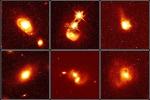 A Quasar Portrait Gallery
6.12.1997
QUASARs (QUASi-stellAR objects) lie near the edge of the observable Universe. Discovered in 1963, astronomers were astounded that such objects could be visible across billions of light-years, as this implies they must emit prodigious amounts of energy. Where does the energy come from?
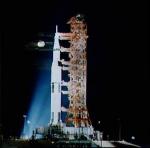 The Last Moon Shot
17.06.2000
In 1865 Jules Verne predicted the invention of a space capsule that could carry people. In his science fiction story "From the Earth to the Moon", he outlined his vision of a cannon in Florida so powerful that it could shoot a "Projectile-Vehicle" carrying three adventurers to the Moon.
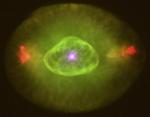 NGC 6826: The Blinking Eye
26.05.2001
The colorful planetary nebula phase of a sun-like star's life is brief. Almost in the "blink of an eye" - cosmically speaking - the star's outer layers are cast off, forming an expanding emission nebula. This nebula lasts perhaps 10 thousand years compared to a 10 billion year stellar life span.
 A Radar Image of Planet Earth
24.08.1995
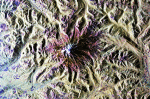
This image of Mt. Rainier, Washington USA, planet Earth, was produced by the Spaceborne Radar Laboratory which flew on the Space Shuttle Endeavour in 1994. Radar, short for RAdio Detection And Ranging...
 Aurora and Orion
14.11.1995
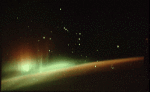
Looking toward the south from low Earth orbit, the crew of the Space Shuttle Endeavor made this stunning time exposure of the Aurora Australis (southern lights) in April of 1994. The aurora are caused by high energy electrons from the Solar Wind which are funneled into the atmosphere by the Earth's magnetic field.
 From Eagle's EGGs A Star Is Born
19.01.1997
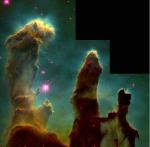
Perhaps the most famous astronomical image in recent years reveals newborn stars upon pillars of gas and dust - uncovered as researchers used the Hubble Space Telescope to explore the Eagle Nebula in 1995. This...
 NGC 5307: A Symmetric Planetary Nebula
31.12.1997
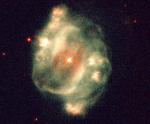
Some stellar nebulae are strangely symmetric. For example, every major blob of gas visible on the upper left of NGC 5307 appears to have a counterpart on the lower right. This picture taken by the Hubble Space Telescope was released last week. NGC 5307 is an example of a planetary nebula with a spiral shape.
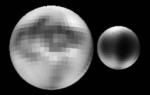 Mysterious Pluto and Charon
8.07.1998
Pluto is the only planet in our Solar System remaining unphotographed by a passing spacecraft. Distant Pluto and its moon Charon therefore remain somewhat mysterious. In addition to direct imaging by the Hubble Space...
|
January February March April May June July August September October |
|||||||||||||||||||||||||||||||||||||||||||||||||