
|
You entered: dark
 APOD: 2024 December 2 Б NGC 300: A Galaxy of Stars
2.12.2024
This galaxy is unusual for how many stars it seems that you can see. Stars are so abundantly evident in this deep exposure of the spiral galaxy NGC 300 because so many of these stars are bright blue and grouped into resolvable bright star clusters.
 The Equal Night
23.09.2000
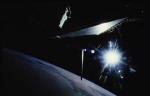
Yesterday the Sun crossed the celestial equator heading south, marking the Equinox -- the first day of Autumn in the northern hemisphere and Spring in the south. Equinox means equal night and with the Sun on the celestial equator, Earthlings will experience 12 hours of daylight and 12 hours of darkness.
 Saturn at the Lunar Limb
22.02.2002
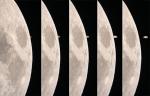
Gliding through the sky on Wednesday evening, February 20th, a first quarter Moon seemed to run over bright planet Saturn as viewed from much of North America. In this sharp sequence of telescopic digital...
 Aurora and Orion
14.11.1995
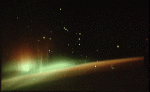
Looking toward the south from low Earth orbit, the crew of the Space Shuttle Endeavor made this stunning time exposure of the Aurora Australis (southern lights) in April of 1994. The aurora are caused by high energy electrons from the Solar Wind which are funneled into the atmosphere by the Earth's magnetic field.
 An Apollo 12 Panorama
2.01.2004
The Apollo 12 mission was the second ever to land humans on the Moon. The mission was dedicated to studying the Moon, developing techniques, and developing instruments that could be used in future lunar landings.
 X-ray Transit of Mercury
2.07.1998
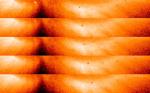
This sequence of false color X-ray images captures a rare event - the passage or transit of planet Mercury in front of the Sun. Mercury's small disk is silhouetted against the bright background of X-rays from the hot Solar Corona.
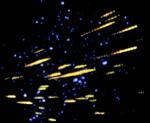 Meteors Now and Again
10.08.1998
The Perseid Meteor Shower, usually the best meteor shower of the year, will peak over the next two nights. Over the course of an hour, a person watching a clear sky from a dark location might see as many as 100 meteors.
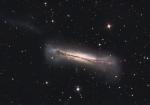 Sideways Galaxy NGC 3628
8.04.2005
Dark dust lanes cutting across the middle of this gorgeous island universe strongly hint that NGC 3628 is a spiral galaxy seen sideways. About 35 million light-years away in the northern springtime constellation...
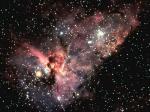 The Keyhole Nebula
23.05.1999
The dark dusty Keyhole Nebula gets its name from its unusual shape. Officially designated NGC 3324, the Keyhole Nebula is a smaller region superposed on the larger Eta Carina Nebula. These nebulae were created by the dying star Eta Carina, which is prone to violent outbursts during its final centuries.
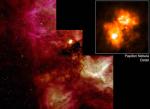 N159 and the Papillon Nebula
14.06.1999
In a search for massive stars, the Hubble Space Telescope has peered into yet another spectacular region of star formation. This nebula, known as N159, spans over 150 light-years and is located in the neighboring Large Magellanic Cloud galaxy, about 170,000 light years distant.
|
January February March April May June July August September |
|||||||||||||||||||||||||||||||||||||||||||||||||