
|
You entered: dark
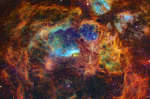 NGC 6357: The Lobster Nebula
28.10.2020
Why is the Lobster Nebula forming some of the most massive stars known? No one is yet sure. Cataloged as NGC 6357, the Lobster Nebula houses the open star cluster Pismis 24 near its center -- a home to unusually bright and massive stars.
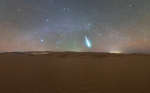 Gemind of the North
17.12.2021
An arid expanse of the Tengger Desert in north-central China, planet Earth fills the foreground of this starry scene. A widefield panoramic view, it was recorded shortly after moonset in the local predawn hours of December 14. Pictured in the still dark sky, stars of the northern winter hexagon surround a luminous Milky Way.
 The Double Cluster in Perseus
7.07.2023
This pretty starfield spans about three full moons (1.5 degrees) across the heroic northern constellation of Perseus. It holds the famous pair of open star clusters, h and Chi Persei. Also cataloged...
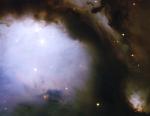 Reflection Nebula M78
11.02.2002
An eerie blue glow and ominous columns of dark dust highlight M78, one of the brightest reflection nebula on the sky. M78 is visible with a small telescope toward the constellation of Orion. The dust not only absorbs light, but also reflects the light of several bright blue stars that formed recently in the nebula.
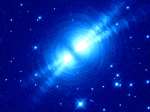 Searchlight Beams from the Egg Nebula
29.01.1996
The dramatic and mysterious looking object revealed in this Hubble Space Telescope image is known as the Egg Nebula. It is an aging star about 3,000 lightyears distant, entering its Planetary Nebula phase of evolution.
 A Wind From The Sun
17.02.1997
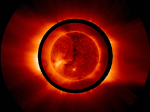
A wind from the Sun blows through our Solar System. The behaviour of comet tails as they flapped and waved in this interplanetary breeze gave astronomers the first hint of its existence. Streaming outward...
 Old Faithful Meets Hale-Bopp
26.05.1997
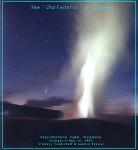
As Comet Hale-Bopp leaves our Northern Skies, it provides us with yet another burst of joy. On May 11th the fading comet was photographed behind the famous "Old Faithful" water geyser of Yellowstone National Park, Wyoming, USA, Planet Earth.
 Noctilucent Clouds Over Sweden
18.07.2006
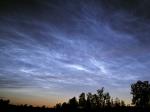
Sometimes it's night on the ground but day in the air. As the Earth rotates to eclipse the Sun, sunset rises up from the ground. Therefore, at sunset on the ground, sunlight still shines on clouds above.
 Brown Sun Bubbling
10.01.2000
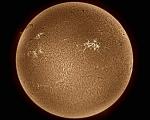
Our Sun may look like all soft and fluffy, but its not. Our Sun is an extremely large ball of bubbling hot gas, mostly hydrogen gas. The above picture was taken in a specific color of light emitted by hydrogen gas called Hydrogen-alpha.
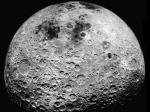 The Far Side of the Moon
25.02.2007
Does this moon look familiar? Possibly not, even though it is Earth's Moon. Locked in synchronous rotation, the Moon always presents its well-known near side to Earth. But from lunar orbit, Apollo astronauts also grew to know the Moon's far side.
|
January February March April May June July August September |
|||||||||||||||||||||||||||||||||||||||||||||||||