
|
You entered: dark
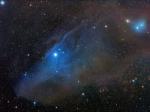 Horse Head Shaped Reflection Nebula IC 4592
8.08.2006
Do you see the horse's head? What you are seeing is not the famous Horsehead nebula toward Orion but rather a fainter nebula that only takes on a familiar form with deeper imaging. The main part of the above imaged molecular cloud complex is a reflection nebula cataloged as IC 4592.
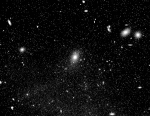 The Virgo Cluster of Galaxies
20.02.2000
Pictured are several galaxies of the Virgo Cluster, the closest cluster of galaxies to our Milky Way Galaxy. The Virgo Cluster spans more than 5 degrees on the sky - about 10 times the angle made by a full Moon. It contains over 100 galaxies of many types - including spirals, ellipticals, and irregular galaxies.
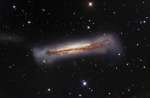 Sideways Galaxy NGC 3628
15.05.2008
Dark dust lanes cut across the middle of this gorgeous island universe, a strong hint that NGC 3628 is a spiral galaxy seen sideways. About 35 million light-years away in the northern springtime constellation...
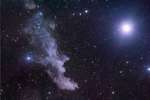 A Witch by Starlight
31.10.2008
By starlight this eerie visage shines in the dark, a crooked profile evoking its popular name, the Witch Head Nebula. In fact, this entrancing telescopic portrait gives the impression the witch has fixed her gaze on Orion's bright supergiant star Rigel.
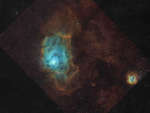 The Lagoon Nebula in Gas, Dust, and Stars
22.07.2009
Stars are battling gas and dust in the Lagoon Nebula but the photographers are winning. Also known as M8, this photogenic nebula is visible even without binoculars towards the constellation of Sagittarius. The energetic processes of star formation create not only the colors but the chaos.
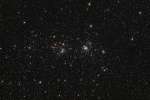 The Double Cluster
4.12.2009
A lovely starfield in the heroic northern constellation Perseus holds this famous pair of open or galactic star clusters, h and Chi Perseii. Also cataloged as NGC 869 (right) and NGC 884, both clusters are about 7,000 light-years away and contain stars much younger and hotter than the Sun.
 Panorama of the Whale Galaxy
17.05.2010
The see the full length of this blue whale, scroll right. NGC 4631 is a big beautiful spiral galaxy seen edge-on at only about 30 million light-years away. This galaxy's slightly distorted wedge shape led to its popular moniker of the Whale galaxy.
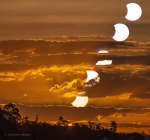 Brisbane Sunset Moonset
1.05.2014
In skies over Brisbane at the southeastern corner of Queensland, Australia, Planet Earth, the Sun and New Moon set together on April 29. There the celestial line-up, the first solar eclipse of 2014, was seen as a partial solar eclipse.
 La Palma Eclipse Sequence
7.10.2015
At left, a dramatic image sequence follows late September's total lunar eclipse above a rugged landscape and sea of clouds from the Canary island of La Palma. Composited in a circular fisheye projection...
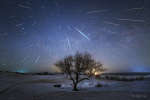 Gemini s Meteors
22.12.2017
From dark skies above Heilongjiang province in northeastern China, meteors rain down on a wintry landscape in this beautiful composited night scene. The 48 meteors are part of last week's annual Geminid meteor shower.
|
January February March April May June July August September |
|||||||||||||||||||||||||||||||||||||||||||||||||