
|
You entered: Moon
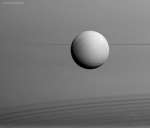 Dione, Rings, Shadows, Saturn
24.08.2015
What's happening in this strange juxtaposition of moon and planet? First and foremost, Saturn's moon Dione was captured here in a dramatic panorama by the robotic Cassini spacecraft currently orbiting the giant planet. The bright and cratered moon itself spans about 1100-km, with the large multi-ringed crater Evander visible on the lower right.
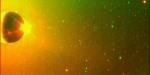 Io's Sodium Cloud
28.04.1997
Io has its own cloud. Jupiter's most active moon is visible on the left of the above false-color photograph, with its left side illuminated by sunlight. But what is happening on Io's right side? Here a plume of gas from the active volcano Prometheus also reflects sunlight.
 A Sunrise at Sunset Point
19.10.2023
This timelapse series captured on October 14 is set against the sunrise view from Sunset Point, Bryce Canyon, planet Earth. Of course on that date the New Moon caught up with the Sun in the canyon's morning skies.
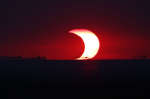 A Partial Eclipse Over Manila Bay
20.05.2012
What's happened to the setting Sun? An eclipse! In early 2009, the Moon eclipsed part of the Sun as visible from parts of Africa, Australia, and Asia. In particular the above image, taken from the Mall of Asia seawall, caught a partially eclipsed Sun setting over Manila Bay in the Philippines.
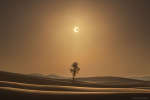 A Desert Eclipse
13.01.2020
A good place to see a ring-of-fire eclipse, it seemed, would be from a desert. In a desert, there should be relatively few obscuring clouds and trees. Therefore late last December a group...
APOD: 2026 April 22 Б Earthset with an iPhone
22.04.2026
What does it mean for the Earth to set? Artemis II Commander Reid Wiseman gave us another spectacular view of Earth from their historic flyby of the Moon. Commander Wiseman's video, taken with an iPhone at 8x zoom, shows our entire planet gradually blocked from view by the Moon.
 America and the Sea of Serenity
17.01.2024
Get out your red/blue glasses and check out this stereo view of another world. The scene was recorded by Apollo 17 mission commander Eugene Cernan on December 11, 1972, one orbit before descending to land on the Moon.
 The Ecliptic Plane
27.09.1997
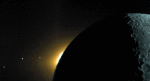
The Plane of the Ecliptic is illustrated in this Clementine star tracker camera image which reveals (from right to left) the Moon lit by Earthshine, the Sun's corona rising over the Moon's dark limb, and the planets Saturn, Mars, and Mercury.
 Sunset, Moonset
7.01.2011
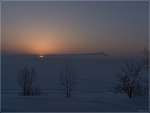
Seen from central and northern Asia, the Sun and New Moon set together on January 4, in a partial solar eclipse. Close to its maximum phase, the eclipse is captured near the moment of sunset in this wintry scene from the bank of the Berd River near Novosibirsk, Siberia, Russia.
 A Total Solar Eclipse of Saros 145
11.08.2017
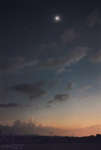
A darkened sky holds bright planet Venus, the New Moon in silhouette, and the shimmering corona of the Sun in this image of a total solar eclipse. A composite of simultaneous telephoto and wide angle frames it was taken in the path of totality 18 years ago, August 11, 1999, near Kastamonu, Turkey.
|
January February March April May June July August September October |
|||||||||||||||||||||||||||||||||||||||||||||||||