
|
You entered: Moon
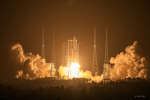 Chang e 5 Mission Launch
27.11.2020
This Long March-5 rocket blasted off from the Wenchang launch site in southernmost Hainan province on Tuesday November 24, at 4:30 am Beijing Time, carrying China's Chang'e-5 mission to the Moon. The lunar landing mission is named for the ancient Chinese goddess of the moon.
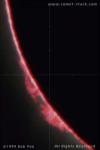 At The Suns Edge
20.08.1999
This dramatic set of prominences looms beyond the edge of the sun. The image was captured by astrophotographer Bob Yen as he stood in the moon's shadow near Bagdere, Turkey on August 11 for the millennium's last total solar eclipse.
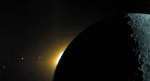 The Ecliptic Plane
29.05.1999
The Plane of the Ecliptic is illustrated in this Clementine star tracker camera image which reveals (from right to left) the Moon lit by Earthshine, the Sun's corona rising over the Moon's dark limb, and the planets Saturn, Mars, and Mercury.
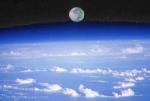 Moonrise, Planet Earth
27.05.1997
During the Astro-1 astronomy mission of December, 1990, Space Shuttle astronauts photographed this stunning view of the full moon rising above the Earth's limb. In the foreground, towering clouds of condensing water vapor mark the extent of the troposphere, the lowest layer of the planet's life-sustaining atmosphere.
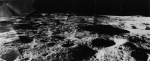 Surveyor Hops
5.12.1998
This panorama of the cratered lunar surface was constructed from images returned by the US Surveyor 6 lander. Surveyor 6 was not the first spacecraft to accomplish a soft landing on the Moon ... but it was the first to land and then lift off again!
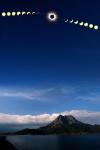 A Total Solar Eclipse over Turkey
4.04.2006
Some views of last week's total eclipse of the Sun were better than others. One spectacular view occurred over Adrasan (near Antalya), Turkey and was captured there by industrious astrophotographer Stefan Seip. The above digital mosaic caught the Moon in several stages as it moved between the Earth and the Sun.
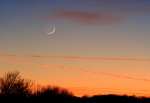 Mercury Chases the Sunset
12.01.2008
This colorful view of the western sky at sunset features last Wednesday's slender crescent Moon. Of course, when the Moon is in its crescent phase it can never be far from Sun in the sky.
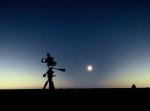 Shadow Cone of a Total Solar Eclipse
6.01.2003
Sometimes, during a total eclipse of the Sun, a strange shadow of darkness can be seen stretching off into the distance. Called a shadow cone, they are visible because the Earth's atmosphere is not completely transparent, scattering sunlight and hence appearing blue during the day.
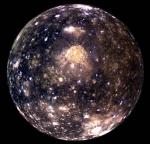 Callisto Enhanced
12.05.1998
Callisto is half rock and half ice. This moon of Jupiter is approximately the size of the planet Mercury, making it the third largest moon in the Solar System, after Ganymede and Titan. Callisto...
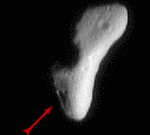 An Unexpected Asteroid Valentine
14.02.2000
Maybe the Moon owns our hearts, but this won't stop the occasional asteroid from sending us a valentine. Friday, to the surprise of many, the NEAR mission on approach to asteroid 433 EROS photographed what appears to be a heart-shaped depression.
|
January February March April May June July August September October |
|||||||||||||||||||||||||||||||||||||||||||||||||