
|
You entered: planets
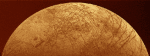 Europa: Ancient Water World
5.09.1995
Beneath the cold icy surface of Jupiter's moon Europa are probably the only oceans of water in our Solar System outside of Earth. These oceans, possibly 50 kilometers deep, might also be the most likely local place to find extra-terrestrial life.
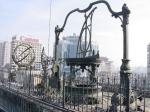 Beijing Ancient Observatory
29.03.2003
Did observatories exist before telescopes? One example that still stands today is the Beijing Ancient Observatory in China. Starting in the 1400s astronomers erected large instruments here to enable them to measure star and planet positions with increasing accuracy.
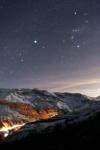 Alborz Mountains in Moonlight
2.02.2007
On January 25th, light from a first quarter Moon illuminated this dreamlike landscape looking across the rugged, snow-covered peaks of the Alborz Mountain Range in northern Iran. The stunning sky is filled with stars, including the yellow-tinged Betelgeuse at the shoulder of Orion.
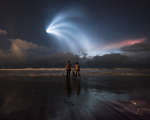 Skygazers on the Beach
12.10.2018
Kona, a young boxer, is a dog who loves splashing in the waves along Solana Beach near San Diego, planet Earth. But he paused here, at least briefly, during an early evening romp on October 7.
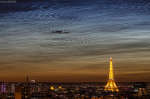 A Solstice Night in Paris
27.06.2019
The night of June 21 was the shortest night for planet Earth's northern latitudes, so at latitude 48.9 degrees north, Paris was no exception. Still, the City of Light had an exceptionally luminous evening. Its skies were flooded with silvery night shining or noctilucent clouds after the solstice sunset.
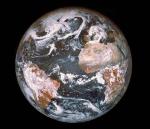 An Earth Ornament
24.12.1999
The Apollo 8 astronauts spent the 1968 Christmas Season orbiting the Moon, returning with striking images of both Moon and Earth from space - pictures which inspired the world. While in lunar orbit...
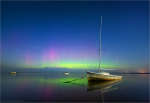 Calm Waters and Geomagnetic Storm
8.09.2017
Very recognizable stars of the northern sky are a backdrop for calm waters in this moonlit sea and skyscape off Cape Cod, Massachusetts. Taken on September 7, the photo also records a colorful display of northern lights or aurora borealis triggered by a severe geomagnetic storm.
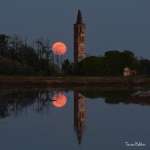 Full Flower Moonrise
8.05.2020
Rising as the Sun set, the Moon was bright and full in planet Earth skies on May 7 and known to some as a Flower Moon. Near the horizon it does seem to take on rose pink hues of reddened sunlight in this reflective twilight scene.
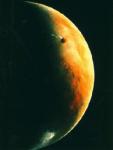 Barsoom
31.03.2001
"Yes, I have been to Barsoom again ..." begins John Carter in Edgar Rice Burroughs' 1913 science fiction classic "The Gods of Mars". In Burroughs' novels describing Carter's adventures on Mars, "Barsoom" is the local inhabitants' name for the Red Planet. Long after Burroughs' stories were published, Mars continues to inspire Earthdwellers' interests and imagination.
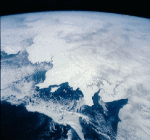 Water World
17.11.1995
Water (Dihydrogen Oxide, H2O) is a truly remarkable chemical compound and is fundamental to life on Earth. Earth is the only planet in the Solar System where the surface temperature and pressure allow the three forms of water, solid (ice), liquid (ocean), and gas (water vapor condensing in clouds) to exist simultaneously on its surface.
|
January February March April May June July August September October |
|||||||||||||||||||||||||||||||||||||||||||||||||