
|
You entered: planets
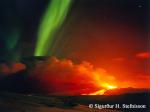 Volcano and Aurora in Iceland
29.01.2006
Sometimes both heaven and Earth erupt. In Iceland in 1991, the volcano Hekla erupted at the same time that auroras were visible overhead. Hekla, one of the most famous volcanoes in the world, has erupted at least 20 times over the past millennium, sometimes causing great destruction.
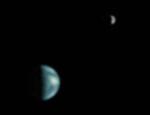 The Earth and Moon from Mars
26.05.2003
What does Earth look like from Mars? The first image of Earth from the red planet was captured earlier this month by the camera onboard the Mars Global Surveyor spacecraft currently orbiting Mars. Features visible on Earth include the Pacific Ocean, clouds, much of South America, and part of North America.
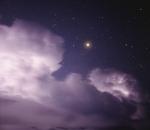 A Dark and Stormy Night
31.10.2003
It was a dark and stormy night. But on August 29th the red planet Mars, near it's closest approach to Earth in almost 60,000 years, shone brightly in the sky against a background of stars in the constellation Aquarius.
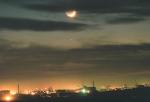 Moon Over Mongolia
16.09.1997
Fighting clouds and the glow of city lights, a young Moon shines over the western horizon of Mongolia's capital Ulaan-Baatar. The thin sunlit crescent is 1.5 days old and strongly over exposed in this image taken on March 10.
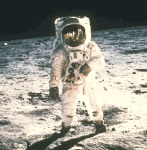 Standing on the Moon
22.09.1995
Pictured, the second person to walk on the Moon: Edwin "Buzz" Aldrin. During this Apollo 11 mission, Neil Armstrong and Buzz Aldrin landed on the Moon while Michael Collins circled in the Command Module above.
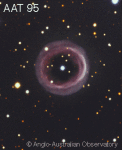 Shapley 1: An Annular Planetary Nebula
12.12.1995
This strange structure is what can result when a normal star runs out of nuclear fuel in its core. At that time, the center condenses into a white dwarf while the outer atmospheric layers are expelled into space and appear as a planetary nebula.
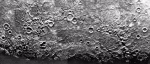 Mercury's Caloris Basin
20.01.1996
Mercury, the closest planet to the Sun, has a surface with so many craters it resembles the Earth's Moon. The largest surface feature on Mercury is the Caloris Basin, which resulted from a collision with an asteroid.
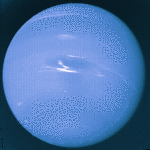 Neptune: Big Blue Giant
21.02.1998
This picture was taken by the Voyager 2 spacecraft in 1989 - the only spacecraft ever to visit Neptune. Neptune will be the farthest planet from the Sun until 1999, when the elliptical orbit of Pluto will cause it to once again resume this status.
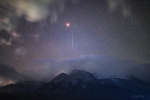 Mars and Meteor over Jade Dragon Snow Mountain
21.11.2020
A brilliant yellowish celestial beacon, Mars still dazzles in the night. Peering between clouds the wandering planet was briefly joined by the flash of a meteor in this moonless dark sky on November 18. The single exposure was taken as the Earth swept up dust from periodic comet Tempel-Tuttle during the annual Leonid Meteor Shower.
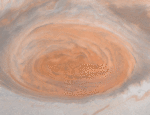 Galileo Zooms in on Jupiter's Red Spot
27.08.1996
What does the largest storm system ever recorded look like close-up? This storm system is Jupiter's Great Red Spot and it was captured recently in detail by the robot spacecraft Galileo now in orbit around Jupiter.
|
January February March April May June July August September October |
|||||||||||||||||||||||||||||||||||||||||||||||||