
|
You entered: planets
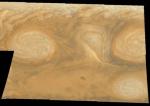 White Oval Clouds on Jupiter
8.08.1997
What are those white ovals all over Jupiter? Storms! Jupiter's clouds can swirl rapidly in raised high-pressure storm systems that circle the planet. The above pictured white ovals are located near the Great Red Spot, and have persisted on Jupiter since the 1930s. The Great Red Spot has persisted for at least 300 years.
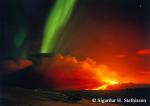 Volcano and Aurora in Iceland
21.01.2002
Sometimes both heaven and Earth erupt. In Iceland in 1991, the volcano Hekla erupted at the same time that auroras were visible overhead. Hekla, one of the most famous volcanoes in the world, has erupted at least 20 times over the past millennium, sometimes causing great destruction.
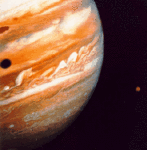 Jupiter, Io, and Ganymede's Shadow
13.10.1995
Jupiter, the solar system's largest planet, is seen here next to Io, its closest Galilean moon. On the cloud tops of Jupiter near the left edge of the picture can be seen a dark circular spot which is caused by the shadow of Jupiter's largest moon Ganymede.
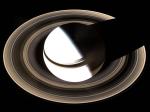 Saturn from Above
6.03.2007
This image of Saturn could not have been taken from Earth. No Earth based picture could possibly view the night side of Saturn and the corresponding shadow cast across Saturn's rings. Since Earth is much closer to the Sun than Saturn, only the day side of the planet is visible from the Earth.
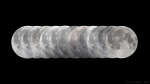 An Almost Eclipse of the Moon
18.01.2020
This composited series of images follows the Moon on January 10, the first Full Moon of 2020, in Hungarian skies. The lunar disk is in mid-eclipse at the center of the sequence though. It looks only slightly darker there as it passes through the light outer shadow or penumbra of planet Earth.
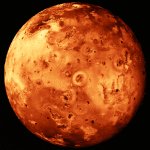 Io: A Volcanic Moon
3.08.1995
In 1610, Galileo turned his telescope to the heavens and discovered that the planet Jupiter had four bright moons. The innermost of these Galilean moons, Io, turned out to be one of the most exotic objects in the solar system.
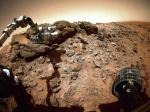 Attacking Mars
13.03.2007
The Spirit rover attacked Mars again in 2005 September. What might look, above, like a military attack, though, was once again just a scientific one - Spirit was instructed to closely inspect some interesting rocks near the summit of Husband Hill.
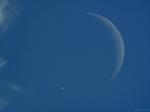 A Daylight Eclipse of Venus
20.06.2007
Something was about to happen. Just two days ago, two of the three celestial objects easily visible during the day appeared to collide. But actually, Earth's Moon passed well in front of the distant planet Venus. The occultation was caught from Switzerland in the hours before sunset.
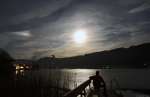 Serene Paraselene
2.04.2010
Nestled in the Austrian Alps, frozen Lake Ossiach stretches across the foreground of this serene view. Recorded on March 1, the night sky includes a nearly full Moon and bright planet Saturn seen through thin clouds near picture center. It also includes a remarkably bright and colorful moondog or paraselene at the left.
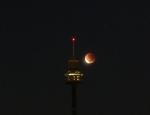 Good Morning Sydney
8.05.2004
Rising before dawn on May 5th, Stephen Thorley looked out across the skyline of Sydney, Australia. And while a leisurely lunar eclipse was clearly in progress, from his vantage point on planet Earth the Moon set as the total phase of the eclipse began.
|
January February March April May June July August September October |
|||||||||||||||||||||||||||||||||||||||||||||||||