
|
You entered: Observatory
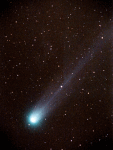 What are Comet Tails Made Of?
26.03.1996
The tail of comet Hyakutake, visible in this recent color image, is composed of dust and gas driven off the icy comet nucleus by the Sun's heat and blown away by the solar wind. Bathed in solar ultraviolet light, the gas molecules break down and are excited, producing a characteristic glow.
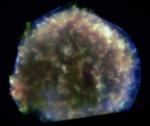 X Rays From Tycho s Supernova Remnant
12.09.2002
In 1572, Danish astronomer Tycho Brahe recorded the sudden appearance of a bright new star in the constellation Cassiopeia. The new star faded from view over a period of months and is believed to have been a supernova, one of the last stellar explosions seen in our Milky Way galaxy.
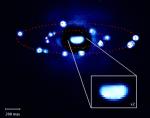 Sylvia, Romulus and Remus
18.08.2005
Discovered in 1866, main belt asteroid 87 Sylvia lies 3.5 AU from the Sun, between the orbits of Mars and Jupiter. Also shown in recent years to be one in a growing list...
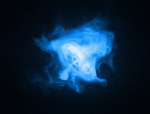 Crab Pulsar Wind Nebula
27.12.2008
The Crab Pulsar, a city-sized, magnetized neutron star spinning 30 times a second, lies at the center of this remarkable image from the orbiting Chandra Observatory. The deep x-ray image gives the first clear view of the convoluted boundaries of the Crab's pulsar wind nebula.
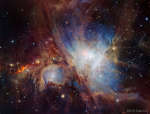 The Orion Nebula in Infrared from HAWK I
18.07.2016
The deepest infrared image of the Orion Nebula has uncovered a bonanza of previously unknown low-mass stars and -- quite possibly -- free floating planets. The picturesque nebula is best known in visible light where it shows a many bright stars and bright glowing gas.
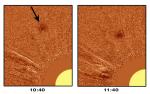 Coronal Inflow
29.11.2001
The active Sun has thrown a lot our way lately, including storms of particles streaming outward in the solar wind and clouds of plasma which triggered awesome auroral displays. Still, a growing body...
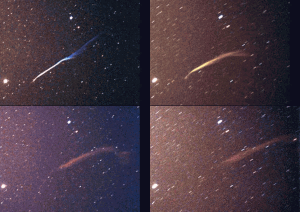 Meteor Storm Sights and Sounds
30.11.2001
This dramatic four-frame animation shows a fireball meteor and its developing persistent "smoke" train, recorded two weeks ago in skies near Salvador, Brazil. Indeed similar sights are astonishingly familiar world-wide to witnesses of this November's fireball-rich Leonid meteor storm.
 M83: The Southern Pinwheel
16.01.2025
Beautiful and bright spiral galaxy M83 lies a some twelve million light-years away, near the southeastern tip of the very long constellation Hydra. Prominent spiral arms traced by dark dust lanes and blue star clusters lend this galaxy its popular name, The Southern Pinwheel.
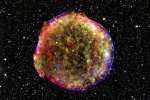 Tychos Supernova Remnant
17.03.2009
What star created this huge puffball? Pictured above is the best multi-wavelength image yet of Tycho's supernova remnant, the result of a stellar explosion first recorded over 400 years ago by the famous astronomer Tycho Brahe.
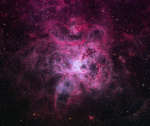 The Tarantula Nebula
17.11.2018
The Tarantula Nebula, also known as 30 Doradus, is more than a thousand light-years in diameter, a giant star forming region within nearby satellite galaxy the Large Magellanic Cloud. About 180 thousand light-years away, it's the largest, most violent star forming region known in the whole Local Group of galaxies.
|
January February March April May June July August September October |
|||||||||||||||||||||||||||||||||||||||||||||||||