
|
You entered: Observatory
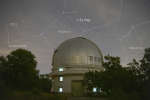 50 Light years to 51 Pegasi
9.10.2021
It's only 50 light-years to 51 Pegasi. That star's position is indicated in this snapshot from August, taken on a hazy night with mostly brighter stars visible above the dome at Observatoire de Haute-Provence in France.
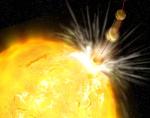 HD 82943: Planet Swallower
18.05.2001
Stars like HD 82943 are main sequence G dwarf stars with temperatures and compositions similar to the Sun. Also like the Sun, HD 82943 is known to have at least two giant planets, but unlike gas giants in our solar system their orbits are not nearly circular and bring them closer to the parent star.
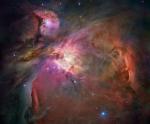 Orion Nebula, The Hubble View
19.01.2006
Few cosmic vistas excite the imagination like the Orion Nebula. Also known as M42, the nebula's glowing gas surrounds hot young stars at the edge of an immense interstellar molecular cloud only 1,500 light-years away.
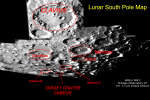 Target Crater Cabeus
8.10.2009
About 100 kilometers from the Moon's South Pole, 100 kilometer wide crater Cabeus is the target for two LCROSS mission spacecraft on course to impact the Moon tomorrow. The shadowed crater is strongly foreshortened in this mosaic, a representative view of the region for earthbound telescopes.
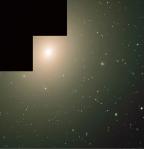 Young Star Clusters in an Old Galaxy
4.07.2002
Elliptical galaxy NGC 4365 is old, probably about 12 billion years old. Like most elliptical galaxies, this galaxy was thought to be full of old stars too, its burst of star forming activity having long since ended.
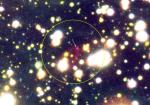 The Nebula And The Neutron Star
1.02.2003
The lonely RX J1856.5-3754 was formed from the collapsed core of an exploding star. At a distance of 180 light-years it is the closest known neutron star. More massive than...
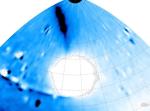 Shadow Of A Comet
2.07.1999
Hale-Bopp, the Great Comet of 1997, may have been the most viewed comet in history - visible even from bright metropolitan skies. Astronomers are now reporting that this magnificent comet also cast a shadow against the glare of the solar system's ultraviolet haze.
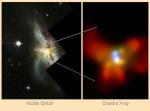 The Supermassive Black Holes of NGC 6240
28.11.2002
The Hubble optical image on the left shows NGC 6240 in the throes of a titanic galaxy - galaxy collision 400 million light-years away. As the cosmic catastrophe plays out, the merging galaxies spew forth distorted tidal tails of stars, gas, and dust and undergo frantic bursts of star formation.
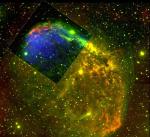 NGC 6888: X Rays in the Wind
16.10.2003
NGC 6888, also known as the Crescent Nebula, is a cosmic bubble of interstellar gas about 25 light-years across. Created by winds from the bright, massive star seen near the center of this composite image, the shocked filaments of gas glowing at optical wavelengths are represented in green and yellowish hues.
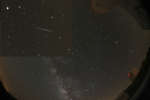 A Twisted Meteor Trail Over Tenerife
2.06.2010
Did this meteor take a twisting path? No one is sure. Considered opinions are solicited. Meteors, usually sand sized grains that originate in comets, will typically disintegrate as they enter the Earth's atmosphere. A fast moving meteor ionizes molecules in the Earth's atmosphere that subsequently glow when they reacquire electrons.
|
January February March April May June July August September October |
|||||||||||||||||||||||||||||||||||||||||||||||||