
|
You entered: Observatory
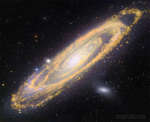 The Once and Future Stars of Andromeda
23.05.2022
This picture of Andromeda shows not only where stars are now, but where stars will soon be. Of course, the big, beautiful Andromeda Galaxy, M31, is a spiral galaxy -- and a mere 2.5 million light-years away.
 The Once and Future Stars of Andromeda
7.10.2023
This picture of Andromeda shows not only where stars are now, but where stars will be. The big, beautiful Andromeda Galaxy, M31, is a spiral galaxy a mere 2.5 million light-years away. Image data...
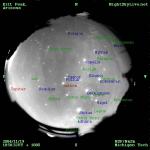 Leonid Meteors Streak
23.11.2004
The 2004 Leonids meteor shower had its ups and downs. Although average rates were significantly less than many previous years, as expected, at least two unexpected "mini-outbursts" of several bright meteors over a few minutes were reported.
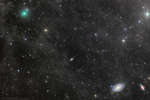 Comet ATLAS and the Mighty Galaxies
21.03.2020
Comet ATLAS C/2019 Y4 was discovered by the NASA funded Asteroid Terrestrial-impact Last Alert System, the last comet discovery reported in 2019. Now growing brighter in northern night skies, the comet's pretty greenish...
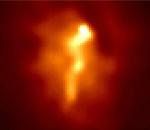 Abell 1795: A Galaxy Cluster s Cooling Flow
8.12.2000
Throughout the Universe, galaxies tend to swarm in groups ranging from just a handful of members to casts of thousands. Astronomers have realized since the early 1970s that the larger swarms, immense clusters of galaxies millions of light-years across, are immersed within tenuous clouds of hot gas which glow strongly in x-rays.
 M16: Stars, Pillars and the Eagle s EGGs
3.01.2002
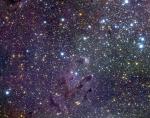
The Hubble Space Telescope's 1995 image of pillars of dust and gas, light-years long, within the Eagle Nebula (M16) was sensational. The three prominent pillars in that close-up visible light picture also appear...
 Abell 2597 s Cosmic Cavities
16.01.2002
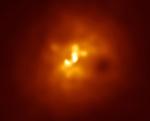
Typical of large galaxy clusters billions of light-years away, Abell 2597 features hundreds of galaxies embedded in a cloud of multimillion degree gas which glows in x-rays. This Chandra Observatory x-ray image shows...
 The Eskimo Nebula from Hubble and Chandra
30.07.2013
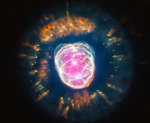
In 1787, astronomer William Herschel discovered the Eskimo Nebula. From the ground, NGC 2392 resembles a person's head surrounded by a parka hood. In 2000, the Hubble Space Telescope imaged the Eskimo Nebula in visible light, while the nebula was imaged in X-rays by the Chandra X-ray Observatory in 2007.
 Simulation: Two Black Holes Merge
14.04.2019
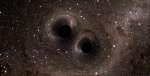
Sit back and watch two black holes merge. Inspired by the first direct detection of gravitational waves in 2015, this simulation video plays in slow motion but would take about one third of a second if run in real time.
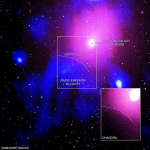 An Extreme Black Hole Outburst
11.03.2020
Astronomers believe they have now found the most powerful example of a black hole outburst yet seen in our Universe. The composite, false-color featured image is of a cluster of galaxies in the constellation of Ophiuchus, the serpent-bearer.
|
January February March April May June July August September October |
|||||||||||||||||||||||||||||||||||||||||||||||||