
|
You entered: Observatory
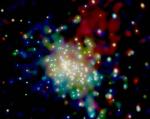 X Ray Mystery in RCW 38
26.12.2002
A mere 6,000 light-years distant and sailing through the constellation Vela, star cluster RCW 38 is full of powerful stars. It's no surprise that these stars, only a million years young with hot outer atmospheres, appear as point-like x-ray sources dotting this x-ray image from the orbiting Chandra Observatory.
 Deep Magellanic Clouds Image Indicates Collisions
24.07.2016
Did the two most famous satellite galaxies of our Milky Way Galaxy once collide? No one knows for sure, but a detailed inspection of deep images like that featured here give an indication that they have.
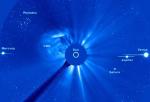 Pleiades, Planets, And Hot Plasma
24.05.2000
Bright stars of the Pleiades, four planets, and erupting solar plasma are all captured in this spectacular image from the space-based SOlar and Heliospheric Observatory (SOHO). In the foreground of the 15 degree wide field of view, a bubble of hot plasma, called a Coronal Mass Ejection (CME)
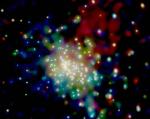 X Ray Mystery in RCW 38
7.01.2005
A mere 6,000 light-years distant and sailing through the constellation Vela, star cluster RCW 38 is full of powerful stars. It's no surprise that these stars, only a million years young with hot outer atmospheres, appear as point-like x-ray sources dotting this x-ray image from the orbiting Chandra Observatory.
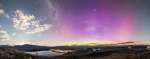 Aurora over New Zealand
26.02.2014
Sometimes the more you look at an image, the more you see. Such may be the case for this beautiful nighttime panorama taken last week in New Zealand. Visible right off, on the far left, are common clouds, slightly altered by the digital fusion of combining 11 separate 20-second exposures.
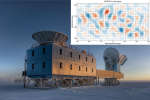 Cosmic Microwave Map Swirls Indicate Inflation
18.03.2014
Did the universe undergo an early epoch of extremely rapid expansion? Such an inflationary epoch has been postulated to explain several puzzling cosmic attributes such as why our universe looks similar in opposite directions.
 APOD: 2023 November 21 Б Flemings Triangular Wisp
20.11.2023
These chaotic and tangled filaments of shocked, glowing gas are spread across planet Earth's sky toward the constellation of Cygnus as part of the Veil Nebula. The Veil Nebula itself is a large supernova remnant, an expanding cloud born of the death explosion of a massive star.
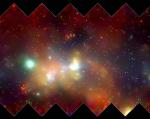 X Ray Milky Way
9.01.2002
If you had x-ray vision, the center regions of our galaxy would not be hidden from view by immense cosmic dust clouds opaque to visible light. Instead, the Milky Way toward Sagittarius might look something like this stunning mosaic of images from the orbiting Chandra Observatory.
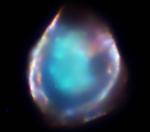 DEM L71: When Small Stars Explode
13.03.2003
Large, massive stars end their furious lives in spectacular supernova explosions -- but small, low mass stars may encounter a similar fate. In fact, instead of simply cooling off and quietly fading away, some white...
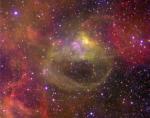 Energized Nebula in the LMC
10.04.2003
Blossoming in nearby galaxy the Large Magellanic Cloud (LMC), this gorgeous nebula is energized by radiation and winds from a massive star whose surface temperature approaches 100,000 degrees. The composite color image from...
|
January February March April May June July August September October |
|||||||||||||||||||||||||||||||||||||||||||||||||