
|
You entered: Observatory
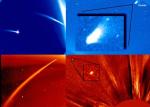 The Comets Of SOHO
25.02.2000
After four years of successful sun-gazing, the space-based SOlar and Heliospheric Observatory (SOHO) has also become the most successful comet-hunter in history, racking up 102 new comets. Above are examples of SOHO's comet discoveries imaged by LASCO, an on-board coronagraph.
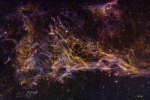 Pickerings Triangle from Kitt Peak
1.07.2008
Wisps like this are all that remain visible of a Milky Way star. About 7,500 years ago that star exploded in a supernova leaving the Veil Nebula, also known as the Cygnus Loop.
 SDO s Multiwavelength Sun
21.12.2013
Today, the solstice is at 17:11 Universal Time, the Sun reaching the southernmost declination in its yearly journey through planet Earth's sky. The December solstice marks the astronomical beginning of winter in the northern hemisphere and summer in the south.
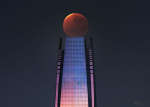 Lunar Eclipse over a Skyscraper
22.11.2021
Why is the Moon on top of this building? Planning. It took the astrophotographer careful planning -- including figuring out exactly where to place the camera and exactly when to take the shot -- to create this striking superposition.
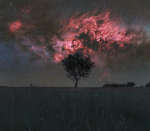 APOD: 2026 March 18 Б Cygnus and the Solitary Tree
18.03.2026
A lone tree stands in a quiet meadow in Guadalajara, Spain, silhouetted against the Cygnus region rising above like flames in the night sky. This deep night skyscape is a composite of exposures that reveals a range of brightness and color human eyes can't quite see on their own.
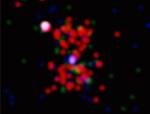 3C294: Distant X Ray Galaxy Cluster
22.02.2001
Large clusters of galaxies are the most massive objects in the universe. Astronomers now realize that a hallmark of these cosmic behemoths are gas clouds with temperatures of tens of millions of degrees that pervade the clusters and radiate strongly in x-rays.
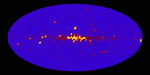 The X-Ray Sky
2.01.1996
What if you could see X-rays? If you could, the night sky would be a strange and unfamiliar place. X-rays are about 1,000 times more energetic than visible light photons and are produced in violent and high temperature astrophysical environments.
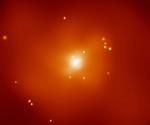 Dark Matter, X rays, and NGC 720
26.10.2002
Elliptical galaxy NGC 720 is enveloped in a cosmic cloud of x-ray emitting gas. Seen in this false color image from the Chandra X-ray Observatory, the extreme temperature of the gas - about 7 million...
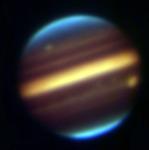 WIRO at Jupiter
13.03.2003
Gazing out over the mountaintops from the Wyoming InfraRed Observatory (WIRO), astronomers recently recorded this bizarre looking image of the solar system's ruling planet, gas giant Jupiter. The false-color picture is a composite...
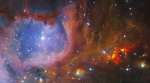 Messier 43
10.07.2015
Often imaged but rarely mentioned, Messier 43 is a large star forming region in its own right. It's just part of the star forming complex of gas and dust that includes the larger, more famous neighboring Messier 42, the Great Orion Nebula.
|
January February March April May June July August September October |
|||||||||||||||||||||||||||||||||||||||||||||||||