
|
You entered: Observatory
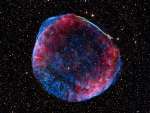 SN 1006 Supernova Remnant
1.08.2009
A new star, likely the brightest supernova in recorded human history, lit up planet Earth's sky in the year 1006 AD. The expanding debris cloud from the stellar explosion, found in the southerly constellation of Lupus, still puts on a cosmic light show across the electromagnetic spectrum.
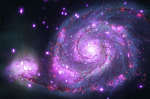 M51: X Rays from the Whirlpool
10.06.2014
What if we X-rayed an entire spiral galaxy? This was done (again) recently by NASA's Chandra X-ray Observatory for the nearby interacting galaxies known as the Whirlpool (M51). Hundreds of glittering x-ray stars are present in the above Chandra image of the spiral and its neighbor.
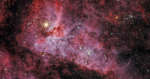 The Great Carina Nebula
26.05.2016
A jewel of the southern sky, the Great Carina Nebula, also known as NGC 3372, spans over 300 light-years, one of our galaxy's largest star forming regions. Like the smaller, more northerly Great...
 Flemings Triangular Wisp
26.07.2021
Chaotic in appearance, these tangled filaments of shocked, glowing gas are spread across planet Earth's sky toward the constellation of Cygnus as part of the Veil Nebula. The Veil Nebula itself is a large supernova remnant, an expanding cloud born of the death explosion of a massive star.
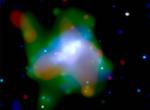 NGC 1569: Heavy Elements from a Small Galaxy
25.07.2002
For astronomers, elements other than hydrogen and helium are sometimes considered to be simply "heavy elements". It's understandable really, because even lumped all together heavy elements make up an exceedingly small fraction of the Universe. Still, heavy elements can profoundly influence galaxy and star formation ... not to mention the formation of planets and people.
 192: The Wrong Galaxy
13.01.2003
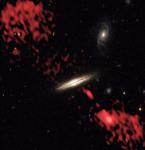
Centered above is distant galaxy 0313-192, some one billion light-years away. Radio emission from the galaxy has been mapped by the National Radio Astronomy Observatory's Very Large Array and is shown in red, composited with a visible light image from the Hubble Space Telescope's new Advanced Camera for Surveys.
 ULXs in M74
30.03.2005
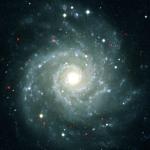
In visual appearance, M74 is a nearly perfect face-on spiral galaxy, about 30 million light-years away toward the constellation Pisces. The red blotches seen in this composite view are ultraluminous x-ray sources (ULXs) mapped by the Chandra X-ray Observatory.
 Peculiar Arp 295
8.10.2005
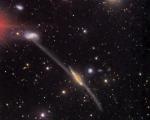
A spectacular bridge of stars and gas stretches for nearly 250,000 light-years and joins this famous peculiar pair of galaxies cataloged as Arp 295. The cosmic bridge between the galaxies and the long...
 Gamma Ray Earth
3.06.2006
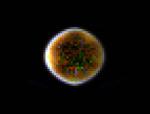
The pixelated planet above is actually our own planet Earth seen in gamma rays - the most energetic form of light. In fact, the gamma rays used to construct this view pack over 35 million electron volts (MeV) compared to a mere two electron volts (eV) for a typical visible light photon.
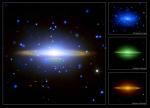 Sombrero Galaxy Across the Spectrum
5.05.2007
Appropriately famous for its broad ring of obscuring dust and hat-like appearance, the Sombrero Galaxy (aka spiral galaxy M104) is featured in this unique composite view that spans the electromagnetic spectrum, from three major space-based observatories.
|
January February March April May June July August September October |
|||||||||||||||||||||||||||||||||||||||||||||||||