
|
You entered: Observatory
 APOD: 2026 February 11 Б A Year of Sunspots
11.02.2026
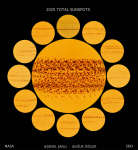
How many sunspots can you see? The central image shows the many sunspots that occurred in 2025, month by month around the circle, and all together in the grand central image. Each sunspot is magnetically cooled and so appears dark -- and can last from days to months.
 Mount Megantic Magnetic Storm
17.08.2000
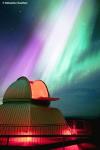
Plasma from the Sun and debris from a comet both collided with planet Earth last Saturday morning triggering magnetic storms and a meteor shower in a dazzling atmospheric spectacle. The debris stream from comet...
 Hale Bopp: A Continuing Tail
20.02.1998
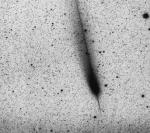
Where is Hale-Bopp now? The Great Comet of 1997, one of the largest and most active comets ever, is outbound about 400 million miles from the sun. Too faint for viewing without telescopes or binoculars, Hale-Bopp is presently positioned in the very southerly constellation of Pictor.
 Infrared Portrait of the Large Magellanic Cloud
15.01.2012
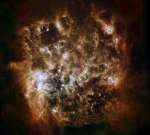
Cosmic dust clouds ripple across this infrared portrait of our Milky Way's satellite galaxy, the Large Magellanic Cloud. In fact, the remarkable composite image from the Herschel Space Observatory and the Spitzer Space Telescope show that dust clouds fill this neighboring dwarf galaxy, much like dust along the plane of the Milky Way itself.
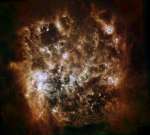 Infrared Portrait of the Large Magellanic Cloud
23.03.2013
Cosmic dust clouds ripple across this infrared portrait of our Milky Way's satellite galaxy, the Large Magellanic Cloud. In fact, the remarkable composite image from the Herschel Space Observatory and the Spitzer Space Telescope show that dust clouds fill this neighboring dwarf galaxy, much like dust along the plane of the Milky Way itself.
 The Long Jet of the Lighthouse Nebula
21.02.2014
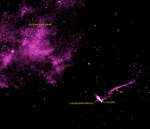
The Lighthouse nebula was formed by the wind of a pulsar, a rapidly rotating, magnetized neutron star, as it speeds through the interstellar medium at over 1,000 kilometers per second. Some...
 Infrared Portrait of the Large Magellanic Cloud
14.01.2016
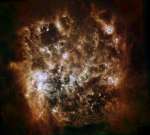
Cosmic dust clouds ripple across this infrared portrait of our Milky Way's satellite galaxy, the Large Magellanic Cloud. In fact, the remarkable composite image from the Herschel Space Observatory and the Spitzer Space Telescope show that dust clouds fill this neighboring dwarf galaxy, much like dust along the plane of the Milky Way itself.
 NGC 6960: The Witchs Broom Nebula
8.04.2018
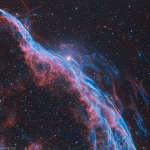
Ten thousand years ago, before the dawn of recorded human history, a new light would have suddenly have appeared in the night sky and faded after a few weeks. Today we know this light was from a supernova, or exploding star, and record the expanding debris cloud as the Veil Nebula, a supernova remnant.
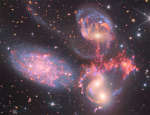 Stephans Quintet from Webb, Hubble, and Subaru
18.07.2022
OK, but why can't you combine images from Webb and Hubble? You can, and today's featured image shows one impressive result. Although the recently launched James Webb Space Telescope (Webb) has a larger mirror than Hubble, it specializes in infrared light and can't see blue -- only up to about orange.
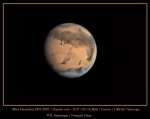 Mars in View
6.12.2007
Very good telescopic views of Mars can be expected in the coming weeks as the Red Planet nears opposition on December 24th. Of course, opposition means opposite the Sun in planet Earth's sky - an arrangement that occurs every 26 months for Mars.
|
January February March April May June July August September October |
|||||||||||||||||||||||||||||||||||||||||||||||||