
|
You entered: Observatory
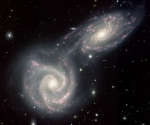 The Colliding Spiral Galaxies of Arp 271
25.08.2013
What will become of these galaxies? Spiral galaxies NGC 5426 and NGC 5427 are passing dangerously close to each other, but each is likely to survive this collision. Typically when galaxies collide, a large galaxy eats a much smaller galaxy.
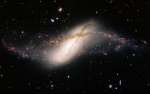 Polar Ring Galaxy NGC 660
7.11.2014
NGC 660 is featured in this cosmic snapshot, a sharp composite of broad and narrow band filter image data from the Gemini North telescope on Mauna Kea. Over 20 million light-years away and swimming within the boundaries of the constellation Pisces, NGC 660's peculiar appearance marks it as a polar ring galaxy.
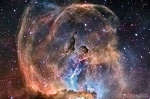 NGC 3576: The Statue of Liberty Nebula
28.09.2016
What's happening in the Statue of Liberty nebula? Bright stars and interesting molecules are forming and being liberated. The complex nebula resides in the star forming region called RCW 57. This image showcases...
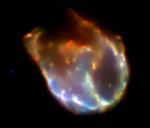 N132D and the Color of X Rays
23.05.2002
Supernova remnant N132D shows off complex structures in this sharp, color x-ray image. Still, overall this cosmic debris from a massive star's explosive death has a strikingly simple horseshoe shape. While N132D lies 180,000 light-years distant in the Large Magellanic Cloud, the expanding remnant appears here about 80 light-years across.
 Afterglow
28.05.1998
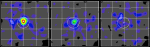
This sequence of three false color X-ray pictures from the Italian/Dutch BeppoSAX satellite follows the fading glow from a gamma-ray burster. This burster triggered orbiting gamma-ray observatories on December 14, 1997 and within 6.5 hours the sensitive X-ray cameras onboard BeppoSAX had been turned to record the first image (left) of the afterglow.
 The Magnetic Carpet Of The Sun
24.10.1999
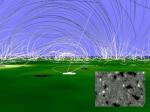
The Sun has a magnetic carpet. Its visible surface appears to be carpeted with tens of thousands of magnetic north and south poles joined by looping field lines which extend outward into the Solar Corona.
 Sagittarius Triplet
4.08.2007
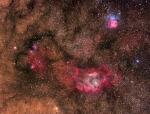
These three bright nebulae are often featured in telescopic tours of the constellation Sagittarius and the crowded starfields of the central Milky Way. In fact, 18th century cosmic tourist Charles Messier cataloged two of them; M8, the nebula below and right of center, and colorful M20 at the upper right.
 SN 1006: Pieces of the Cosmic Ray Puzzle
2.12.2000
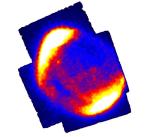
Research balloon flights conducted in 1912 by Austrian physicist Victor Hess revealed that the Earth was constantly bombarded by high energy radiation from space - which came to be called "Cosmic Rays". What are Cosmic Rays and where do they come from?
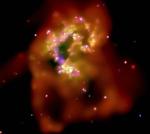 X Rays From Antennae Galaxies
3.02.2004
A bevy of black holes and neutron stars shine as bright, point-like sources against bubbles of million degree gas in this false-color x-ray image from the orbiting Chandra Observatory. The striking picture spans about...
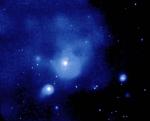 Fornax Cluster in Motion
24.09.2004
Reminiscent of popular images of the lovely Pleiades star cluster that lies within our own Milky Way Galaxy, this false-color x-ray view actually explores the center of a much more extended cosmic family -- the Fornax cluster of galaxies some 65 million light-years away.
|
January February March April May June July August September October |
|||||||||||||||||||||||||||||||||||||||||||||||||