
|
You entered: Observatory
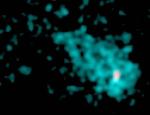 IC443's Neutron Star
14.12.2000
Using x-ray data from the orbiting Chandra Observatory along with radio data from the Very Large Array, a team of researchers has discovered evidence for a new example of one of the most bizarre objects known to modern astrophysics -- a neutron star.
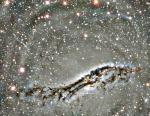 Centaurus A: Young Blue Star Stream
17.10.2002
Almost lost in this cosmic jumble of stars, gas and dust is a faint but definite blue arc -- a stream of young stars whose formation was probably triggered as a small dwarf galaxy was torn apart approaching the giant elliptical galaxy Centaurus A.
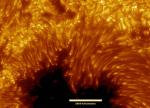 The Sharpest View of the Sun
13.11.2002
This stunning image shows remarkable and mysterious details near the dark central region of a planet-sized sunspot in one of the sharpest views ever of the surface of the Sun. Just released, the picture was made using the Swedish Solar Telescope now in its first year of operation on the Canary Island of La Palma.
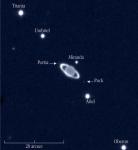 Ringed Planet Uranus
14.01.2003
Yes it does look like Saturn, but Saturn is one of only four giant ringed planets in our Solar System. And while Saturn has the brightest rings, this system of rings and moons actually belongs to planet Uranus, imaged here in near-infrared light by the Antu telescope at the ESO Parnal Observatory in Chile.
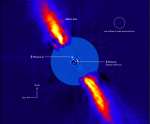 Probably a Planet for Beta Pic
27.11.2008
A mere 50 light-years away, young star Beta Pictoris became one of the most important stars in the sky in the early 1980s. Satellite and ground-based telescopic observations revealed the presence of a surrounding...
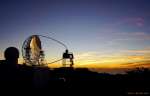 Cherenkov Telescope at Sunset
17.10.2018
On October 10, a new telescope reflected the light of the setting Sun. With dark horizon above and sunset colors below, its segmented mirror inverts an image of the beautiful evening sky in this snapshot from the Roque del Los Muchachos Observatory on the Canary Island of La Palma.
 APOD: 2023 October 11 Б NGC 1097: Spiral Galaxy with Supernova
10.10.2023
What's happening in the lower arm of this spiral galaxy? A supernova. Last month, supernova SN 2023rve was discovered with UAE's Al-Khatim Observatory and later found to be consistent with the death explosion of a massive star, possibly leaving behind a black hole.
 APOD: 2024 July 2 Б NGC 602: Oyster Star Cluster
1.07.2024
The clouds may look like an oyster, and the stars like pearls, but look beyond. Near the outskirts of the Small Magellanic Cloud, a satellite galaxy some 200 thousand light-years distant, lies this 5 million year old star cluster NGC 602.
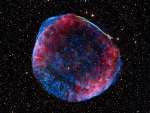 SN 1006 Supernova Remnant
4.07.2008
A new star, likely the brightest supernova in recorded human history, lit up planet Earth's sky in the year 1006 AD. The expanding debris cloud from the stellar explosion, found in the southerly constellation of Lupus, still puts on a cosmic light show across the electromagnetic spectrum.
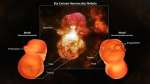 3D Homunculus Nebula
17.07.2014
If you're looking for something to print with that new 3D printer, try out a copy of the Homunculus Nebula. The dusty, bipolar cosmic cloud is around 1 light-year across but is slightly scaled down for printing to about 1/4 light-nanosecond or 80 millimeters.
|
January February March April May June July August September October |
|||||||||||||||||||||||||||||||||||||||||||||||||