
|
You entered: Observatory
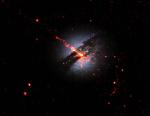 X Ray Jet From Centaurus A
28.10.1999
Spanning over 25,000 light-years, comparable to the distance from the Sun to the center of our own Milky Way galaxy, a cosmic jet seen in X-rays blasts from the center of Centaurus A. Only 10 million light-years away, Centaurus A is a giant elliptical galaxy - the closest active galaxy to Earth.
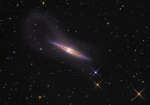 NGC 4013 and the Tidal Stream
7.02.2008
Nearly 50 million light-years away in the constellation Ursa Major, NGC 4013 was long considered an isolated island universe. Seen edge-on, the gorgeous spiral galaxy was known for its flattened disk and central bulge of stars, cut by silhouetted dust lanes.
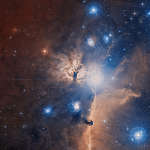 Inside the Flame Nebula
10.05.2014
The Flame Nebula stands out in this optical image of the dusty, crowded star forming regions toward Orion's belt, a mere 1,400 light-years away. X-ray data from the Chandra Observatory and infrared images from the Spitzer Space Telescope can take you inside the glowing gas and obscuring dust clouds though.
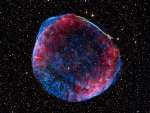 SN 1006 Supernova Remnant
12.07.2014
A new star, likely the brightest supernova in recorded human history, lit up planet Earth's sky in the year 1006 AD. The expanding debris cloud from the stellar explosion, found in the southerly constellation of Lupus, still puts on a cosmic light show across the electromagnetic spectrum.
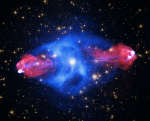 Light from Cygnus A
23.01.2015
Celebrating astronomy in this International Year of Light, the detailed image reveals spectacular active galaxy Cygnus A in light across the electromagnetic spectrum. Incorporating X-ray data ( blue) from the orbiting Chandra Observatory, Cygnus A is seen to be a prodigious source of high energy x-rays.
 APOD: 2024 January 29 Б The Pleiades: Seven Dusty Sisters
29.01.2024
The well-known Pleiades star cluster is slowly destroying part of a passing cloud of gas and dust. The Pleiades is the brightest open cluster of stars on Earth's sky and can be seen from almost any northerly location with the unaided eye.
 Moon Pi and Mountain Shadow
14.03.2025
What phase of the Moon is 3.14 radians from the Sun? The Full Moon, of course. Even though the Moon might look full for several days, the Moon is truly at its full phase when it is Pi radians (aka 180 degrees) from the Sun in ecliptic longitude.
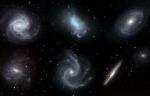 Visitors Galaxy Gallery
27.04.2001
A tantalizing assortment of island universes is assembled here. From top left to bottom right are the lovely but distant galaxies M61, NGC 4449, NGC 4725, NGC 5068, NGC 5247, and NGC 5775/5774. Most are spiral galaxies more or less like our own Milky Way.
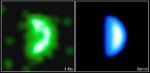 Venusian Half Shell
11.12.2001
Venus, second planet from the Sun, appears above imaged for the first time ever in x-rays (left) by the orbiting Chandra Observatory. Chandra's smoothed, false-color, x-ray view is compared to an optical image (right) from a small earthbound telescope.
 Hubble Telescope Maps Pluto
11.03.1996
No spacecraft from Earth has yet explored Pluto but astronomers have found ways of mapping its surface. A stunning map of this distant, diminutive planet, the first based on direct images, was revealed late last week in a Hubble Space Telescope press release.
|
January February March April May June July August September October |
|||||||||||||||||||||||||||||||||||||||||||||||||