
|
You entered: Observatory
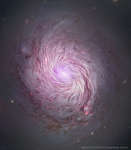 The Magnetic Fields of Spiral Galaxy M77
15.12.2019
Can magnetic fields help tell us how spiral galaxies form and evolve? To find out, the HAWC+ instrument on NASA's airborne (747) SOFIA observatory observed nearby spiral galaxy M77. HAWC+ maps magnetism by observing polarized infrared light emitted by elongated dust grains rotating in alignment with the local magnetic field.
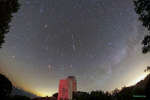 Tau Herculids Meteors over Kitt Peak Telescopes
31.05.2022
It wasn't the storm of the century -- but it was a night to remember. Last night was the peak of the Tau Herculids meteor shower, a usually modest dribble of occasional meteors originating from the disintegrating Comet 73P/Schwassmann-Wachmann 3.
 Moon Pi and Mountain Shadow
13.03.2024
What phase of the Moon is 3.14 radians from the Sun? The Full Moon, of course. Even though the Moon might look full for several days, the Moon is truly at its full phase when it is Pi radians (aka 180 degrees) from the Sun in ecliptic longitude.
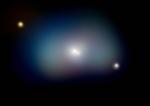 NGC 1700: Elliptical Galaxy and Rotating Disk
15.01.2003
In spiral galaxies, majestic winding arms of young stars and interstellar gas and dust rotate in a disk around a bulging galactic nucleus. Elliptical galaxies seem to be simpler, randomly swarming with old stars and lacking gas and dust.
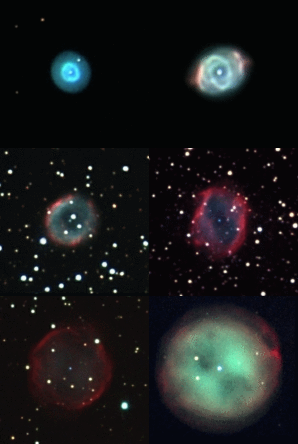 The Planetary Nebula Show
14.06.2003
What do the Owl, the Cat's Eye, the Ghost of Jupiter, and Saturn have in common? They're all planetary nebulae of course, glowing gaseous shrouds shed by dying sun-like stars as they run out of nuclear fuel.
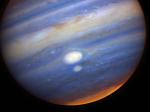 Jupiters Two Largest Storms Nearly Collide
25.07.2006
Two storms systems larger than Earth are nearly colliding right now on planet Jupiter. No one was sure what would happen, but so far both storms have survived. In the above false-color infrared image...
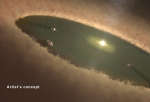 The Double Dust Disks of HD 95086
16.11.2014
What do other star systems look like? To help find out, astronomers are carrying out detailed observations of nearby stars in infrared light to see which have dust disks that might be forming planets.
 An Immersive Visualization of the Galactic Center
21.01.2018
What if you could look out from the center of our Galaxy -- what might you see? Two scientifically-determined possibilities are shown in the featured video, an immersive 360-degree view which allows you to look around in every direction.
 APOD: 2023 March 28 Б A Multiple Green Flash Sunset
27.03.2023
Yes, but can your green flash do this? A green flash at sunset is a rare event that many Sun watchers pride themselvesбon having seen.б Once thought to be a myth, a green flash is now understood to occur when the Earth's atmosphere acts like both a prism and a lens.
 Distortion from a Distant Cluster
23.08.2001
This stunning color deep sky view toward the constellation Pisces was made with data from a fast, sensitive, digital detector known as the Big Throughput Camera operating at Cerro Tololo Inter-American Observatory in Chile.
|
January February March April May June July August September October |
|||||||||||||||||||||||||||||||||||||||||||||||||