
|
You entered: color
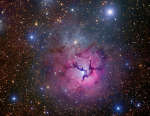 The Trifid Nebula is Stars and Dust
28.07.2010
Unspeakable beauty and unimaginable bedlam can be found together in the Trifid Nebula. Also known as M20, this photogenic nebula is visible with good binoculars towards the constellation of Sagittarius. The energetic processes of star formation create not only the colors but the chaos. The red-glowing gas results from high-energy starlight striking interstellar hydrogen gas.
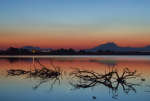 Four Planet Sunset
13.06.2013
You can see four planets in this serene sunset image, created from a series of stacked digital exposures captured near dusk on May 25. The composite picture follows the trail of three of them...
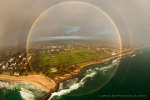 A Full Circle Rainbow over Australia
30.09.2014
Have you ever seen an entire rainbow? From the ground, typically, only the top portion of a rainbow is visible because directions toward the ground have fewer raindrops. From the air, though, the entire 360 degree circle of a rainbow is more commonly visible.
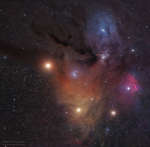 Mars in the Clouds
8.09.2016
Wandering through this stunning field of view, Mars really is in front of these colorful cosmic clouds. The mosaic contructed from telescopic images is about 5 degrees (10 full moons) across. It captures...
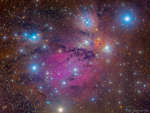 NGC 2170: Angel Nebula Still Life
26.08.2019
Is this a painting or a photograph? In this classic celestial still life composed with a cosmic brush, dusty nebula NGC 2170, also known as the Angel Nebula, shines near the image center. Reflecting...
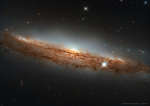 NGC 3717: A Nearly Sideways Spiral Galaxy
12.11.2019
Some spiral galaxies are seen nearly sideways. Most bright stars in spiral galaxies swirl around the center in a disk, and seen from the side, this disk can be appear quite thin. Some spiral galaxies appear even thinner than NGC 3717, which is actually seen tilted just a bit.
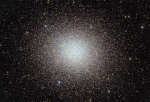 Millions of Stars in Omega Centauri
16.03.2023
Globular star cluster Omega Centauri, also known as NGC 5139, is 15,000 light-years away. The cluster is packed with about 10 million stars much older than the Sun within a volume about 150 light-years in diameter.
 APOD: 2023 June 26 Б The Belt of Venus over Mount Everest
26.06.2023
You've surely seen it, but you might not have noticed it. During a cloudless twilight, just before sunrise or after sunset, part of the atmosphere above the horizon appears slightly dark and off-color.
 APOD: 2024 September 18 Б The Mermaid Nebula Supernova Remnant
18.09.2024
New stars are born from the remnants of dead stars. The gaseous remnant of the gravitational collapse and subsequent death of a very massive star in our Milky Way created the G296.5+10.0 supernova remnant, of which the featured Mermaid Nebula is part.
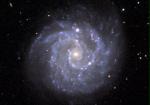 Gangly Spiral Galaxy NGC 3184
20.09.2000
NGC 3184 is a large spiral galaxy with a small nucleus and long sprawling spiral arms. Although NGC 3184 contains hundreds of billions of stars, the blue color of its spiral arms comes mostly from relatively few bright young blue stars.
|
January February March April May June July August September October |
|||||||||||||||||||||||||||||||||||||||||||||||||